
The eBooks we sell are sold as a single-user licence and are intended for the end user only.
The sale of some eBooks are restricted to certain countries. To alert you to such restrictions, please select the country of the billing address of your credit or debit card you wish to use for payment.
For further information see https://www.wildy.com/ebook-formats
Once the order is confirmed an e-mail will be sent to you to allow you to download the eBook. For UK purchases this will be automatic. For purchases outside the UK a member of staff will need to confirm the sale. (Staff are available to do this during normal business hours, Mon-Fri 8:30-17:00 UK time)
All eBooks are supplied firm sale and cannot be returned. If you believe there is a fault with your eBook then contact us on ebooks@wildy.com and we will help in resolving the issue. This does not affect your statutory rights.
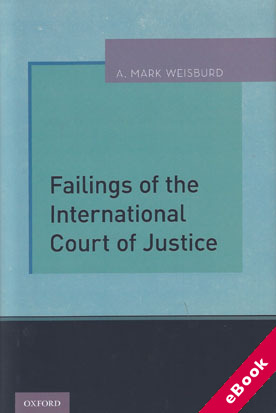
Failings of the International Court of Justice critically examines the jurisprudence of the International Court of Justice. Even though the legal instrument that establishes the Court provides that its judgments have no formal precedential value, those judgments are treated as authoritative by international lawyers throughout the world.
In this book, A. Mark Weisburd argues that the Court's decisions are, in a large minority of cases, poorly reasoned and doubtful as a matter of law, and therefore ought not to be accorded the deference they receive. The book seeks to demonstrate its thesis by a careful review of the Court's errors. It begins with an examination of the law that created and empowered the Court.
It then describes the body of law upon which the Court was intended to base its decisions, and the mistakes in the arguments supporting the Court's drawing legal rules from other sources. The book goes on to analyze in detail cases in which the Court has made serious legal errors, first addressing procedural errors, then turning to mistakes in the application of substantive international law.
The book closes with a quantitative summing up of the Court's performance, and a tentative explanation for its relatively disappointing record.











