
The eBooks we sell are sold as a single-user licence and are intended for the end user only.
The sale of some eBooks are restricted to certain countries. To alert you to such restrictions, please select the country of the billing address of your credit or debit card you wish to use for payment.
For further information see https://www.wildy.com/ebook-formats
Once the order is confirmed an e-mail will be sent to you to allow you to download the eBook. For UK purchases this will be automatic. For purchases outside the UK a member of staff will need to confirm the sale. (Staff are available to do this during normal business hours, Mon-Fri 8:30-17:00 UK time)
All eBooks are supplied firm sale and cannot be returned. If you believe there is a fault with your eBook then contact us on ebooks@wildy.com and we will help in resolving the issue. This does not affect your statutory rights.
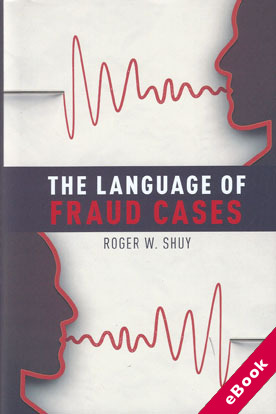
In The Language of Fraud Cases, Roger Shuy follows the now well-established format of his previous volumes on language and law. He discusses here eight cases that he himself has consulted on, and that illustrate how linguistics can help to solve the various problems that arise in trying to define fraudulent language in the context of law.
He examines speech events, schemas, agendas, speech acts, conversational strategies, as well as smaller language units such as sentences, phrases, words, and sounds, and discusses how these can play a major role in deciding fraud cases.
The cases chosen for this volume hinge on recorded language evidence, making them particularly relevant for linguistic analysis, and include cases of government contracts, EPA regulations, foreign corrupt business practices, trade secrets, money laundering, securities trading, art theft, and price fixing.
Through his examination of these cases, Shuy demonstrates the significant contribution of linguistic analytical methodology to the understanding of language evidence and its success in revealing willful uses of fraudulent language to achieve financial gain.










