
The eBooks we sell are sold as a single-user licence and are intended for the end user only.
The sale of some eBooks are restricted to certain countries. To alert you to such restrictions, please select the country of the billing address of your credit or debit card you wish to use for payment.
For further information see https://www.wildy.com/ebook-formats
Once the order is confirmed an e-mail will be sent to you to allow you to download the eBook. For UK purchases this will be automatic. For purchases outside the UK a member of staff will need to confirm the sale. (Staff are available to do this during normal business hours, Mon-Fri 8:30-17:00 UK time)
All eBooks are supplied firm sale and cannot be returned. If you believe there is a fault with your eBook then contact us on ebooks@wildy.com and we will help in resolving the issue. This does not affect your statutory rights.
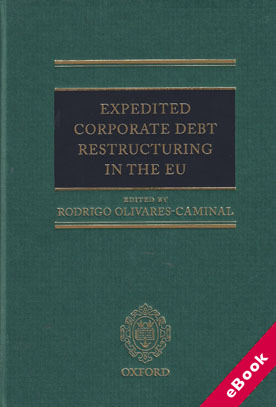
This is the first book to provide a complete comparative analysis of expedited corporate debt restructuring alternatives in the European Union.
The work considers the different options available to a company facing a distress scenario and focuses on the options that provide expedited solutions to these issues. The techniques considered in full include: (1) out-of-court reorganization or (non-insolvency process-related) private workouts; (2) pre-packaged reorganization plans; and, (3) pre-arranged or pre-negotiated reorganization plans.
The merits and suitability of each technique are considered and case studies are used to illustrate these points in each chapter.
A considerable feature of the work is the jurisdiction analysis which allows the reader to compare the law and practice related to each method in each of the EU member states. Each country chapter sets out the relevant legal framework, illustrates its practical application and highlights potential problems through the use of case studies.
The aim of the book is to work as a toolkit, a first point of reference for anyone dealing with companies in distress in the EU. In addition to the jurisdictional analysis, the thematic chapter provide an introduction to the techniques discussed and cover common issues for all EU jurisdictions.











