
The eBooks we sell are sold as a single-user licence and are intended for the end user only.
The sale of some eBooks are restricted to certain countries. To alert you to such restrictions, please select the country of the billing address of your credit or debit card you wish to use for payment.
For further information see https://www.wildy.com/ebook-formats
Once the order is confirmed an e-mail will be sent to you to allow you to download the eBook. For UK purchases this will be automatic. For purchases outside the UK a member of staff will need to confirm the sale. (Staff are available to do this during normal business hours, Mon-Fri 8:30-17:00 UK time)
All eBooks are supplied firm sale and cannot be returned. If you believe there is a fault with your eBook then contact us on ebooks@wildy.com and we will help in resolving the issue. This does not affect your statutory rights.
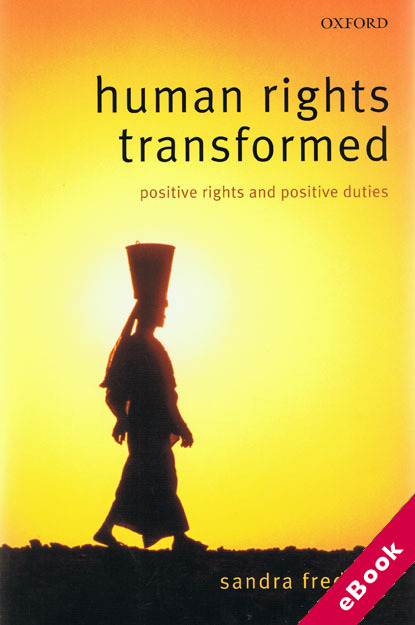
Human rights have traditionally been understood as protecting individual freedom against intrusion by the State. In this book, Sandra Fredman argues that this understanding requires radical revision. Human rights are based on a far richer view of freedom, which goes beyond being let alone, and instead pays attention to individuals' ability to exercise their rights.
This view fundamentally shifts the focus of human rights. As well as restraining the State, human rights require the State to act positively to remove barriers and facilitate the exercise of freedom. This in turn breaks down traditional distinctions between civil and political rights and socio-economic rights. Instead, all rights give rise to a range of duties, both negative and positive. However, because positive duties have for so long been regarded as a question of policy or aspiration, little sustained attention has been given to their role in actualising human rights. Drawing on comparative experience from India, South Africa, the European Convention on Human Rights, the European Union, Canada and the UK, this book aims to create a theoretical and applied framework for understanding positive human rights duties.
Part I elaborates the values of freedom, equality, and solidarity underpinning a positive approach to human rights duties, and argues that the dichotomy between democracy and human rights is misplaced. Instead, positive human rights duties should strengthen rather than substitute for democracy, particularly in the face of globalization and privatization. Part II considers justiciability, fashioning a democratic role for the courts based on their potential to stimulate deliberative democracy in the wider environment. Part III applies this framework to key positive duties, particularly substantive equality and positive duties to provide, traditionally associated with the Welfare State or socio-economic rights.










