
The eBooks we sell are sold as a single-user licence and are intended for the end user only.
The sale of some eBooks are restricted to certain countries. To alert you to such restrictions, please select the country of the billing address of your credit or debit card you wish to use for payment.
For further information see https://www.wildy.com/ebook-formats
Once the order is confirmed an e-mail will be sent to you to allow you to download the eBook. For UK purchases this will be automatic. For purchases outside the UK a member of staff will need to confirm the sale. (Staff are available to do this during normal business hours, Mon-Fri 8:30-17:00 UK time)
All eBooks are supplied firm sale and cannot be returned. If you believe there is a fault with your eBook then contact us on ebooks@wildy.com and we will help in resolving the issue. This does not affect your statutory rights.
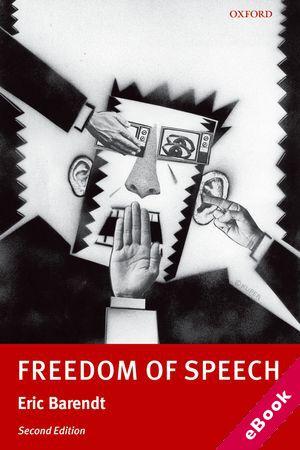
This is a fully revised and updated new edition of the classic work first published in 1985. There have been many important developments since the first edition, including enactment of the Charter of Rights and Freedoms in Canada in 1982, the impact of the European Human Rights Convention, and the consideration by English courts of Judgments of the European Court of Human Rights.
Social and cultural changes mean that free speech claims are being made in novel contexts: to challenge the validity of bans on tobacco advertising, to publish 'kiss and tell' stories about celebrities, and to resist attempts to regulate the Internet. Barendt considers the meaning and scope of freedom of speech. How far do free speech and expression clauses protect pornography, commercial advertising, and public meetings on the streets? Does this freedom cover desecration of a national flag? Does it include nude dancing?
Eric Barendt discusses the legal protection of free speech in countries including England, the United States (including recent decisions of the United States Supreme Court), Canada, Germany, and under the European Human Rights Convention. He examines the varied approaches of different legal systems and constitutional traditions to balancing free speech and freedom of the press against rights to reputation and privacy, and to copyright and explores the case law in light of the philosophical and political arguments for free speech guarantees.










