
The eBooks we sell are sold as a single-user licence and are intended for the end user only.
The sale of some eBooks are restricted to certain countries. To alert you to such restrictions, please select the country of the billing address of your credit or debit card you wish to use for payment.
For further information see https://www.wildy.com/ebook-formats
Once the order is confirmed an e-mail will be sent to you to allow you to download the eBook. For UK purchases this will be automatic. For purchases outside the UK a member of staff will need to confirm the sale. (Staff are available to do this during normal business hours, Mon-Fri 8:30-17:00 UK time)
All eBooks are supplied firm sale and cannot be returned. If you believe there is a fault with your eBook then contact us on ebooks@wildy.com and we will help in resolving the issue. This does not affect your statutory rights.
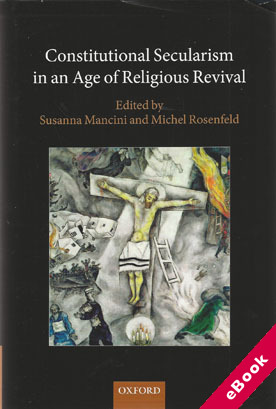
The global movement of culture and religion has brought about a serious challenge to traditional constitutional secularism. This challenge comes in the form of a political and institutional struggle against secular constitutionalism, and a two pronged assault on the very legitimacy and viability of the concept.
On the one hand, constitutional secularism has been attacked as inherently hostile rather than neutral toward religion; and, on the other hand, constitutional secularism has been criticized as inevitably favouring one religion (or set of religions) over others.
The contributors to this book come from a variety of different disciplines including law, anthropology, history, philosophy and political theory. They provide accounts of, and explanations for, present predicaments; critiques of contemporary institutional, political and cultural arrangements, justifications and practices; and suggestions with a view to overcoming or circumventing several of the seemingly intractable or insurmountable current controversies and deadlocks.
The book is separated in to five parts. Part I provides theoretical perspectives on the present day conflicts between secularism and religion. Part II focuses on the relationship between religion, secularism and the public sphere. Part III examines the nexus between religion, secularism and women's equality. Part IV concentrates on religious perspectives on constraints on, and accommodations of, religion within the precincts of the liberal state. Finally, Part V zeroes in on conflicts between religion and secularism in specific contexts, namely education and freedom of speech.










