The eBooks we sell are sold as a single-user licence and are intended for the end user only.
The sale of some eBooks are restricted to certain countries. To alert you to such restrictions, please select the country of the billing address of your credit or debit card you wish to use for payment.
For further information see https://www.wildy.com/ebook-formats
Once the order is confirmed an e-mail will be sent to you to allow you to download the eBook. For UK purchases this will be automatic. For purchases outside the UK a member of staff will need to confirm the sale. (Staff are available to do this during normal business hours, Mon-Fri 8:30-17:00 UK time)
All eBooks are supplied firm sale and cannot be returned. If you believe there is a fault with your eBook then contact us on ebooks@wildy.com and we will help in resolving the issue. This does not affect your statutory rights.
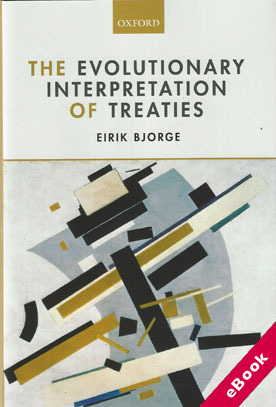
If a treaty from the 1850s regulating 'commerce' or forbidding 'degrading treatment of persons' is to be interpreted 150 years later, does 'commerce' or 'degrading treatment of persons' have the same meaning at the time of interpretation as they had when the treaty was agreed?
The evolutionary interpretation of treaties has proven one of the most controversial topics in the practice of international law. Indeed, it has been seen as going against the very grain of the law of treaties, and has been argued to be contrary to the intention of the parties, breaching the principle of consent.
This book asks what the place of evolutionary interpretation is within the understanding of treaties, at a time when many important international legal instruments are over 50 years old. It sets out to place the evolutionary interpretation of treaties on a firm footing within the general rule of interpretation, as codified in Article 31 of the Vienna Convention on the Law of Treaties.
The book demonstrates that the evolutionary interpretation of treaties - in common with all other types of interpretation such as good faith, the text of the treaty, context, object and purpose - is in fact a based upon an objective understanding of the intention of the parties.
In order to marry intention and evolution in this way, the book argues that, on the one hand, evolutionary interpretation is the product of the correct application of Article 31 and, on the other, that Article 31 is geared towards the establishment of the intention of the parties. The evolutionary interpretation of treaties is therefore shown to represent an intended evolution.