
The eBooks we sell are sold as a single-user licence and are intended for the end user only.
The sale of some eBooks are restricted to certain countries. To alert you to such restrictions, please select the country of the billing address of your credit or debit card you wish to use for payment.
For further information see https://www.wildy.com/ebook-formats
Once the order is confirmed an e-mail will be sent to you to allow you to download the eBook. For UK purchases this will be automatic. For purchases outside the UK a member of staff will need to confirm the sale. (Staff are available to do this during normal business hours, Mon-Fri 8:30-17:00 UK time)
All eBooks are supplied firm sale and cannot be returned. If you believe there is a fault with your eBook then contact us on ebooks@wildy.com and we will help in resolving the issue. This does not affect your statutory rights.
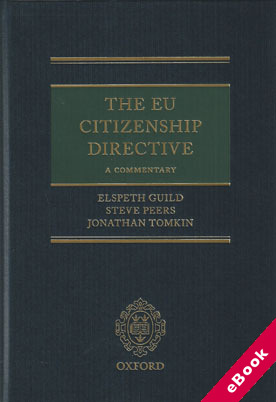
The EU Citizenship Directive defines the right of free movement for citizens of the European Economic Area. It applies to EU citizens and their family members who move to another Member State. This might at first seem like a straightforward definition, but immediately questions arise. Who determines if a person is an EU citizen at all? What about dual citizens of two Member States, or of one Member State and a non-Member State (a 'third State')? What is the position of EU citizens who move to one Member State, and then return to their home Member State?
This book provides a comprehensive commentary of the EU's Citizens' Directive tracing the evolution of the Directive's provisions, placing each article in its historical and legislative context. Special emphasis is placed on highlighting the connections and interactions between the Directive's constituent provisions so as to permit a global appreciation of the system of free movement rights to which the Directive gives effect. Each provision is annotated containing a detailed analysis of the case-law of the Court of Justice as well as of related measures impacting upon the Directive's interpretation including European Commission reports and guidelines on the Directive's implementation. The authors have drawn on their combined experience in academia, practice and the EU institutions to provide an engaging and critical account of the Citizenship Directive, approaching it directly from an EU law perspective.











