
The eBooks we sell are sold as a single-user licence and are intended for the end user only.
The sale of some eBooks are restricted to certain countries. To alert you to such restrictions, please select the country of the billing address of your credit or debit card you wish to use for payment.
For further information see https://www.wildy.com/ebook-formats
Once the order is confirmed an e-mail will be sent to you to allow you to download the eBook. For UK purchases this will be automatic. For purchases outside the UK a member of staff will need to confirm the sale. (Staff are available to do this during normal business hours, Mon-Fri 8:30-17:00 UK time)
All eBooks are supplied firm sale and cannot be returned. If you believe there is a fault with your eBook then contact us on ebooks@wildy.com and we will help in resolving the issue. This does not affect your statutory rights.
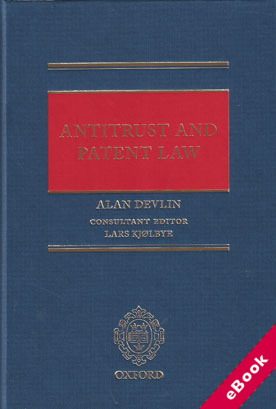
The interface of antitrust and intellectual property (IP) is complex, as the rapid development of technology markets drives rapid evolution in the law. This makes it increasingly important for legal practitioners to have a firm grasp of the policy concerns that inform antitrust limits on the use of proprietary technology.
This book examines the intersection of competition and patent laws from the perspective of both United States (US) and European Union (EU) law; this approach is essential for understanding current developments, as cutting-edge issues play out on both sides of the Atlantic. It also explores the economic theory which underlies the rules in these jurisdictions.
The first part introduces the essential features of antitrust and IP, the fraught boundary between them, and the law's recent developments. It discusses the extent to which the US patent regime is in crisis, and the benefits and dangers of the unified patent system recently adopted in Europe.
The second part explores the idiosyncratic nature of competition analysis of technology markets, and articulates a new framework for understanding antitrust and IP, focusing on the common thread of innovation. The third part explores the most pressing questions in IP-competition law today: the antitrust implications of patent holdup in the form of PAE activity and abuse of the standard-setting process. The fourth part analyses concerted practices surrounding the licensing and use of IPRs, and the controversial practice of pay-for-delay agreements in the pharmaceuticals sector.
The fifth part addresses perhaps the most contentious subject in the competition-IP sphere: the problem of predatory design, anticompetitive innovation, and interoperability requirements. Finally, the book focuses on the procedural and technical aspects of private litigation needed to translate a substantive violation into a realisable remedy.










