
The eBooks we sell are sold as a single-user licence and are intended for the end user only.
The sale of some eBooks are restricted to certain countries. To alert you to such restrictions, please select the country of the billing address of your credit or debit card you wish to use for payment.
For further information see https://www.wildy.com/ebook-formats
Once the order is confirmed an e-mail will be sent to you to allow you to download the eBook. For UK purchases this will be automatic. For purchases outside the UK a member of staff will need to confirm the sale. (Staff are available to do this during normal business hours, Mon-Fri 8:30-17:00 UK time)
All eBooks are supplied firm sale and cannot be returned. If you believe there is a fault with your eBook then contact us on ebooks@wildy.com and we will help in resolving the issue. This does not affect your statutory rights.
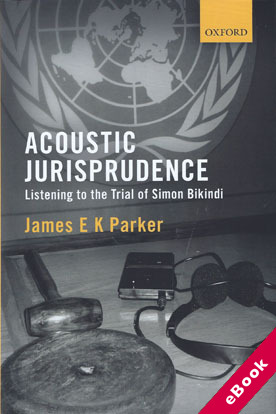
Between September 2006 and December 2008, Simon Bikindi stood trial at the International Criminal Tribunal for Rwanda, accused of inciting genocide with his songs. In the early 1990s, Bikindi had been one of Rwanda's most well-known and popular figures - the country's minister for culture and its most famous and respected singer.
But by the end of 1994, his songs had quite literally soundtracked a genocide. Acoustic Jurisprudence is the first detailed study of the trial that followed. It is also the first work of contemporary legal scholarship to address the many relations between law and sound, which are of much broader importance but which this trial very conspicuously raises.
One half of the book addresses the Tribunal's 'sonic imagination'. How did the Tribunal conceive of Bikindi's songs for the purposes of judgment? How did it understand the role of radio and other media in their transmission? And with what consequences for Bikindi? The other half of the book is addressed to how such concerns played out in court.
Bikindi's was a 'musical trial', as one judge pithily observed. Audio and audio-visual recordings of his songs were played regularly throughout. Witnesses, including Bikindi himself, frequently sang, both of their own accord and at the request of the Tribunal. Indeed, Bikindi even sang his final statement. All the while, judges, barristers, and witnesses alike spoke into microphones and listened through headphones.
As a result, the Bikindi case offers an ideal opportunity to explore what this book calls the 'judicial soundscape'. Through the lens of the Bikindi trial, the book's most important innovation is to open up the field of sound to jurisprudential inquiry. Ultimately, it is an argument for a specifically acoustic jurisprudence.











