The eBooks we sell are sold as a single-user licence and are intended for the end user only.
The sale of some eBooks are restricted to certain countries. To alert you to such restrictions, please select the country of the billing address of your credit or debit card you wish to use for payment.
For further information see https://www.wildy.com/ebook-formats
Once the order is confirmed an e-mail will be sent to you to allow you to download the eBook. For UK purchases this will be automatic. For purchases outside the UK a member of staff will need to confirm the sale. (Staff are available to do this during normal business hours, Mon-Fri 8:30-17:00 UK time)
All eBooks are supplied firm sale and cannot be returned. If you believe there is a fault with your eBook then contact us on ebooks@wildy.com and we will help in resolving the issue. This does not affect your statutory rights.
Non-territorial autonomy (NTA) is a statecraft tool that is increasingly gaining importance in societies seeking to accommodate demands by ethno-cultural groups for a voice in cultural affairs important to the protection and preservation of their identity, such as language, education, and religion. As states recognize the specific rights of identity minorities in multicultural and multi-ethnic societies, they are faced with a need to improve their diversity management regimes. NTA offers policy-makers a range of options for institutional design adaptable to specific circumstances and historical legacies. It devolves degrees of power through legal frameworks and institutions in specific areas of ethno-cultural life, while maintaining social unity at the core level of society. Throughout Europe and North America, NTA exists and is implemented at a state, regional, and local level. Much has been written about the concept of autonomy and its usage as a statecraft tool in states facing regional division, but little literature addresses its non-territorial institutional and public administration functions. This edited volume seeks to fill this gap.
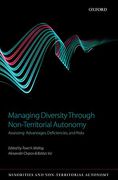
Managing Diversity through Non-Territorial Autonomy: Assessing Advantages, Deficiencies, and Risks, carves a space for contextual knowledge production on NTA in law, as well as social and political sciences. Contextual knowledge involves a description of institutions and their functionality as well as of the institutional and legal frames protecting these. What are the institutions, bodies, and functions that ethno-cultural groups can draw on when seeking to have a voice over their own affairs, as well as over issues in society related to their identity production? How are these entities incorporated and empowered to have a voice? What degree of voice do they have, and how are they designed to project this voice? Thus, contextual knowledge also involves critical assessment and risk analysis as well as penetrating insights as to the unintended consequences and hidden agendas that may inform NTA policies.
This volume is to provide both policy-makers and ethno-cultural groups with a tool-kit that promotes social cohesion while respecting diversity. This is the first volume in a series of five which will examine the protection and representation of minorities through non-territorial means.