We will be closed from 5pm BST on Friday 28th August 2026 for the late summer bank holiday, re-opening at 8.30am BST on Tuesday 1st September. Any orders placed during this period will be processed when we re-open.
The eBooks we sell are sold as a single-user licence and are intended for the end user only.
The sale of some eBooks are restricted to certain countries. To alert you to such restrictions, please select the country of the billing address of your credit or debit card you wish to use for payment.
For further information see https://www.wildy.com/ebook-formats
Once the order is confirmed an e-mail will be sent to you to allow you to download the eBook. For UK purchases this will be automatic. For purchases outside the UK a member of staff will need to confirm the sale. (Staff are available to do this during normal business hours, Mon-Fri 8:30-17:00 UK time)
All eBooks are supplied firm sale and cannot be returned. If you believe there is a fault with your eBook then contact us on ebooks@wildy.com and we will help in resolving the issue. This does not affect your statutory rights.
Due to a technical issue some ebooks are not available to order.
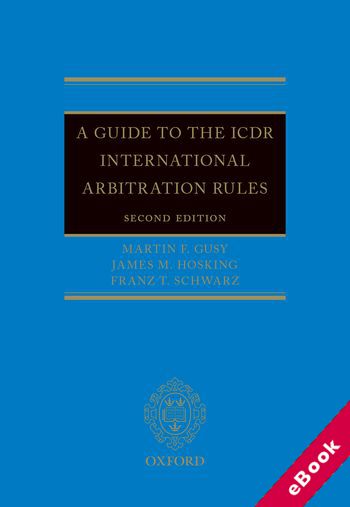
This commentary on the International Centre for Dispute Resolution (ICDR) Rules is a comprehensive reference work for practitioners and arbitrators considering ICDR arbitration.
The second edition is fully revised and updated to reflect the 2014 ICDR Rules revision. The International Centre for Dispute Resolution (ICDR) is the international division of the American Arbitration Association (AAA). Given that in excess of 600 arbitrations are now administered every year under the ICDR Rules, this book answers the need for a comprehensive comparative guide devoted to them. The ICDR International Arbitration Rules are structured in accordance with the typical life-cycle of an international arbitration and the book follows this thematic structure, providing ample cross-referencing to assist the reader in understanding the relationship between the various rules and genuine issues likely to be encountered during an arbitration.
The commentary embraces each of the 39 articles in their entirety and includes discussion of how each provision compares to analogous rules of other major arbitral institutions. The authors draw not only on their own experience, but on caselaw gathered from foreign jurisdictions and from the rich vein of caselaw in the US (applying the ICDR Rules and, where appropriate, analogous provisions of various AAA domestic rules). The work's comparative perspective helps to emphasize key issues to consider when drafting an arbitral clause or strategizing over the conduct of an arbitration.
The second edition of A Guide to the ICDR International Arbitration Rules features multiple appendices and difficult-to-find resources to form a collection of core materials which include the ICDR Rules, the administrative fee schedule, guidelines for exchanges of information, practice notes, and key AAA cooperation agreements with other institutions. Together, Gusy, Hosking, and Schwarz form a strong author team of practitioners whose combined experience includes having co-chaired the ICDR's young Practitioner's group, collaborated with the ICDR, and interviewed key ICDR senior management members.