The eBooks we sell are sold as a single-user licence and are intended for the end user only.
The sale of some eBooks are restricted to certain countries. To alert you to such restrictions, please select the country of the billing address of your credit or debit card you wish to use for payment.
For further information see https://www.wildy.com/ebook-formats
Once the order is confirmed an e-mail will be sent to you to allow you to download the eBook. For UK purchases this will be automatic. For purchases outside the UK a member of staff will need to confirm the sale. (Staff are available to do this during normal business hours, Mon-Fri 8:30-17:00 UK time)
All eBooks are supplied firm sale and cannot be returned. If you believe there is a fault with your eBook then contact us on ebooks@wildy.com and we will help in resolving the issue. This does not affect your statutory rights.
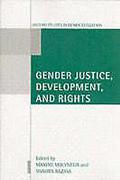
Recent years have seen a shift in the international development agenda in the direction of a greater emphasis on rights and democracy. While this has brought many positive changes in women's rights and political representation, in much of the world these advances were not matched by increases in social justice. Rising income inequalities, coupled with widespread poverty in many countries, have been accompanied by record levels of crime and violence. Meanwhile the global shift in the consensus over the role of the state in welfare provision has in many contexts entailed the down-sizing of public services and the re-allocation of service delivery to commercial interests, charitable groups, NGOs and households. Gender Justice, Development, and Rights reflects on this ambivalent record, and on the significance accorded in international development policy to rights and democracy in the post-Cold War era. Key items on the contemporary policy agenda-neo-liberal economic and social policies; democracy; and multiculturalism-are addressed here by leading scholars and regional specialists through theoretical reflections and detailed case studies.;Together they constitute a collection which casts contemporary liberalism in a distinctive light by applying a gender perspective to the analysis of political and policy processes. Case studies from Latin America, sub-Saharan Africa, Middle East, East-Central Europe, South and South-east Asia contribute a cross-cultural dimension to the analysis of contemporary liberalism-the dominant value system in the modern world-and how it exists, and is resisted, in developing and post-transition societies.