
The eBooks we sell are sold as a single-user licence and are intended for the end user only.
The sale of some eBooks are restricted to certain countries. To alert you to such restrictions, please select the country of the billing address of your credit or debit card you wish to use for payment.
For further information see https://www.wildy.com/ebook-formats
Once the order is confirmed an e-mail will be sent to you to allow you to download the eBook. For UK purchases this will be automatic. For purchases outside the UK a member of staff will need to confirm the sale. (Staff are available to do this during normal business hours, Mon-Fri 8:30-17:00 UK time)
All eBooks are supplied firm sale and cannot be returned. If you believe there is a fault with your eBook then contact us on ebooks@wildy.com and we will help in resolving the issue. This does not affect your statutory rights.
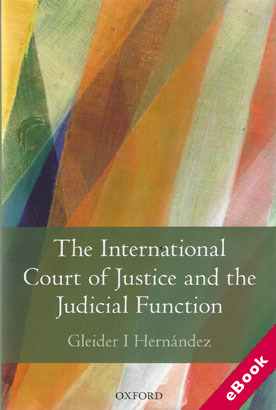
This book evaluates the concept of the function of law through the prism of the International Court of Justice. It goes beyond a conventional analysis of the Court's case law and applicable law, to consider the compromise between supranational order and state sovereignty that lies at the heart of its institutional design.
It argues that this compromise prevents the Court from playing a progressive role in the development of international law. Instead, it influences the international legal order in more subtle ways, in particular, in shaping understanding of the nature or form of the international legal order as a whole.
The book concludes that the role of the Court is not to advance some universal conception of international law but rather to decide the cases before it in the best possible way within its institutional limits, while remaining aware of law's deeper theoretical foundations.
The book considers three key elements: firstly, it examines the historical aspects of the Court's constitutive Statute, and the manner in which it defines its judicial character. Secondly, it considers the drafting process, the function of a dissenting opinion, and the role of the individual judge, in an attempt to discern insights on the function of the Court.
Finally, the book examines the Court's practice in regard to three conceptual issues which assist in understanding the Court's function: its theory of precedent; its definition of the 'international community'; and its theory on the completeness of the international legal order.










