
The eBooks we sell are sold as a single-user licence and are intended for the end user only.
The sale of some eBooks are restricted to certain countries. To alert you to such restrictions, please select the country of the billing address of your credit or debit card you wish to use for payment.
For further information see https://www.wildy.com/ebook-formats
Once the order is confirmed an e-mail will be sent to you to allow you to download the eBook. For UK purchases this will be automatic. For purchases outside the UK a member of staff will need to confirm the sale. (Staff are available to do this during normal business hours, Mon-Fri 8:30-17:00 UK time)
All eBooks are supplied firm sale and cannot be returned. If you believe there is a fault with your eBook then contact us on ebooks@wildy.com and we will help in resolving the issue. This does not affect your statutory rights.
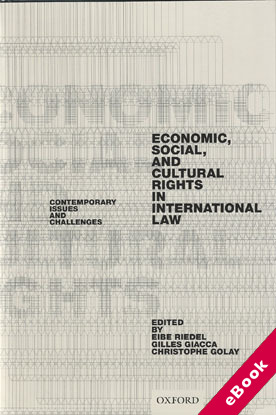
Recent years have seen an expansion in the scale and importance of economic, social, and cultural rights within international law.
This has led to the adoption of the Optional Protocol to the International Covenant on Economic, Social and Cultural Rights in December 2008, giving individuals and groups the ability to bring complaints about violations of these rights before the UN Committee on Economic, Social and Cultural Rights. In this context, this book assesses how effective efforts have been to realise international ESC rights, investigating the contemporary challenges obstructing their protection.
It investigates the impact of the global financial crisis, the need for ESC rights to be implemented in a non-discriminatory manner, and the interrelationship between ESC rights and other international legal regimes. It provides a careful analysis of the new tools and indicators available to measure the progressive realisation of ESC rights.
This book clarifies and illuminate the multiple aspects of the law governing ESC rights, by bringing together all the different aspects of ESC rights, re-stating the challenges they face, and assessing the progress that has been made in expanding their adoption. After an introduction by the editors on ESC rights and the contemporary issues in their realization, the book contains over twenty essays on the main issues related to the progressive realization of ESC rights and their monitoring mechanisms.
The authors of the chapters, both scholars and practitioners, take an interdisciplinary approach to move beyond the traditional analysis of ESC rights, contextualizing their discussions against wider contemporary international law challenges. In reflecting this diversity of perspectives, the book sheds light on the new methodologies for implementation and the many obstacles faced by the realization of ESC rights. It is invaluable reading for scholars, students, practitioners, and NGOs working with or studying ESC rights.










