
The eBooks we sell are sold as a single-user licence and are intended for the end user only.
The sale of some eBooks are restricted to certain countries. To alert you to such restrictions, please select the country of the billing address of your credit or debit card you wish to use for payment.
For further information see https://www.wildy.com/ebook-formats
Once the order is confirmed an e-mail will be sent to you to allow you to download the eBook. For UK purchases this will be automatic. For purchases outside the UK a member of staff will need to confirm the sale. (Staff are available to do this during normal business hours, Mon-Fri 8:30-17:00 UK time)
All eBooks are supplied firm sale and cannot be returned. If you believe there is a fault with your eBook then contact us on ebooks@wildy.com and we will help in resolving the issue. This does not affect your statutory rights.
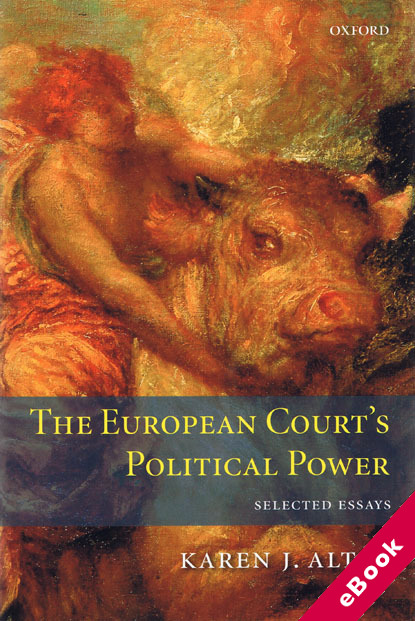
Karen Alter's work on the European Court of Justice heralded a new level of sophistication in the political analysis of the controversial institution, through its combination of legal understanding and active engagement with theoretical questions. The European Court's Political Power assembles the most important of Alter's articles written over a fourteen year span, adding an original new introduction and conclusion taking an overview of the Court's development and current concerns.
Together the articles provide insight into the historical and political contours of the ECJ's influence on European politics, explaining how and why the same institution can have such a varying impact across time and issue area. The book starts with the European Coal and Steel Community, where the ECJ was largely unable to facilitate greater member state respect for ECSC rules. Alter then shows how legal actors orchestrated an activist transformation of the European legal system-with the critical aid of jurist advocacy movements, and via the co-optation national courts. The transformation of the European legal system wrested from member states control over the meaning of European law, but the ECJ continues to have differential influence across issue area. Alter explains that different influence of the ECJ comes from the varied extent to which sub and supra-national actors turn to the ECJ to achieve political objectives.
Looking beyond the European experience, the book includes four chapters that put the ECJ into a comparative perspective, examining the extent to which the ECJ experience is unique, or a harbinger of the future role international courts may play in international and comparative politics.










