
The eBooks we sell are sold as a single-user licence and are intended for the end user only.
The sale of some eBooks are restricted to certain countries. To alert you to such restrictions, please select the country of the billing address of your credit or debit card you wish to use for payment.
For further information see https://www.wildy.com/ebook-formats
Once the order is confirmed an e-mail will be sent to you to allow you to download the eBook. For UK purchases this will be automatic. For purchases outside the UK a member of staff will need to confirm the sale. (Staff are available to do this during normal business hours, Mon-Fri 8:30-17:00 UK time)
All eBooks are supplied firm sale and cannot be returned. If you believe there is a fault with your eBook then contact us on ebooks@wildy.com and we will help in resolving the issue. This does not affect your statutory rights.
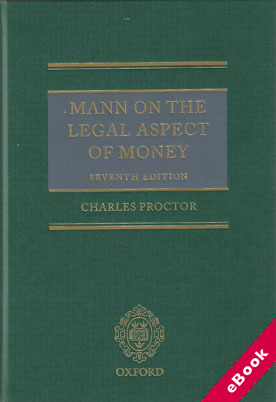
Providing a thorough legal analysis of money in all its aspects, Mann on the Legal Aspect of Money has been the leading text on the private and public law of money ever since the publication of the first edition in 1939.
This latest edition considers issues that arose in the course of the financial crisis, including the legal aspects of the Greek financial crisis, the implications of quantitative easing and the "lender of last resort" function of the central bank. Additionally, there is a new chapter on payment processes following the Payment Services Directive and legislation designed to reinforce legal arrangements in the context of payment systems.
In a private law context, the book deals with the nature of money and its use in the payment of private debts and the right to interest and damages in the event of a delay in the payment of a monetary obligation. It also addresses the implications of money laundering regulations, sanctions and similar legislation in the context of monetary obligations. From a public law perspective, it explores the legal consequences of inflation and the erosion of monetary value as well as the structure of national monetary systems, including monetary pegs, currency boards and dollarization.
In an international law context, the legal implications of monetary associations are considered including economic and monetary union in Europe. The text also considers the legal implications of fluctuating exchange rates and international obligations in relation to the national currency (e.g. exchange rate manipulation and discriminatory monetary practices).
The seventh edition of Mann gives an up-to-date and detailed discussion of current matters, whilst continuing to provide an in-depth analysis on all aspects of monetary law in a single reference source.










