
The eBooks we sell are sold as a single-user licence and are intended for the end user only.
The sale of some eBooks are restricted to certain countries. To alert you to such restrictions, please select the country of the billing address of your credit or debit card you wish to use for payment.
For further information see https://www.wildy.com/ebook-formats
Once the order is confirmed an e-mail will be sent to you to allow you to download the eBook. For UK purchases this will be automatic. For purchases outside the UK a member of staff will need to confirm the sale. (Staff are available to do this during normal business hours, Mon-Fri 8:30-17:00 UK time)
All eBooks are supplied firm sale and cannot be returned. If you believe there is a fault with your eBook then contact us on ebooks@wildy.com and we will help in resolving the issue. This does not affect your statutory rights.
Due to a technical issue some ebooks are not available to order.
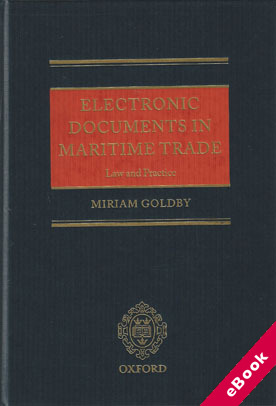
The focus of this work is on the function of electronic documents in cross-border business-to-business contracts for the sale of goods carried by sea. It provides a practical analysis of this commercial activity, examining recent trends in practice and testing the ability of electronic alternatives to achieve legal functions performed by the paper documents they replace.
The book covers the relevant legal barriers and standards including the issue of fraud, in particular the problem of confidence as a practical bar to uptake, and also the laws relating to electronic signatures and data protection. EU laws governing the use of information technology in business contexts are examined. Practical barriers to the use of electronic documents are also considered including a detailed look at specific systems for payment processing, the issue and transfer of rights over goods in transit, and cargo insurance. Demand and supply of alternative systems is also discussed as are the risks and liabilities involved in the use of such systems, and infrastructural problems that may require legislative and/or regulatory intervention to be resolved.
Much has been written about legal aspects of the use of the electronic medium in the conduct of business, but this is the only book to focus specifically on the use of electronic documents in maritime trade covering all of the potential obstacles and providing solutions to those problems. The book examines the issues that arise when attempting to conclude such complex transactions, making it an invaluable reference for anyone contemplating using or advising on paperless trade and its legal implications.










