
The eBooks we sell are sold as a single-user licence and are intended for the end user only.
The sale of some eBooks are restricted to certain countries. To alert you to such restrictions, please select the country of the billing address of your credit or debit card you wish to use for payment.
For further information see https://www.wildy.com/ebook-formats
Once the order is confirmed an e-mail will be sent to you to allow you to download the eBook. For UK purchases this will be automatic. For purchases outside the UK a member of staff will need to confirm the sale. (Staff are available to do this during normal business hours, Mon-Fri 8:30-17:00 UK time)
All eBooks are supplied firm sale and cannot be returned. If you believe there is a fault with your eBook then contact us on ebooks@wildy.com and we will help in resolving the issue. This does not affect your statutory rights.
Due to a technical issue some ebooks are not available to order.
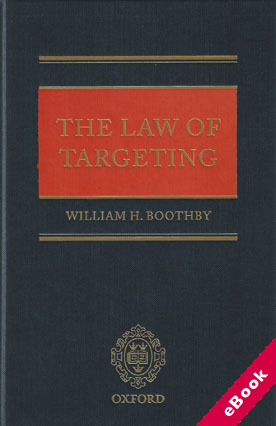
Targeting is the primary method for securing strategic objectives in an armed conflict.
Failure to comply with the law of targeting jeopardizes the achievement of those aims.
It is therefore essential that all those involved in or studying issues surrounding targeting have an accurate and complete understanding of this area of law. This book offers the definitive and comprehensive statement of all aspects of the law of targeting.
It is a 'one-stop shop' that answers all relevant questions in depth. It has been written in an open, accessible yet comprehensive style, and addresses both matters of established law and issues of topical controversy.
The text explains the meanings of such terms as 'civilian', 'combatant', and 'military objective'. Chapters are devoted to the core targeting principles of distinction, discrimination, and proportionality, as well as to the relationship between targeting and the protection of the environment and of objects and persons entitled to special protection.
New technologies are also covered, with chapters looking at attacks using unmanned platforms and a discussion of the issues arising from cyber warfare. The book also examines recent controversies and perceived ambiguities in the rules governing targeting, including the use of human shields, the level of care required in a bombing campaign, and the difficulties involved in determining whether someone is directly participating in hostilities.










