
The eBooks we sell are sold as a single-user licence and are intended for the end user only.
The sale of some eBooks are restricted to certain countries. To alert you to such restrictions, please select the country of the billing address of your credit or debit card you wish to use for payment.
For further information see https://www.wildy.com/ebook-formats
Once the order is confirmed an e-mail will be sent to you to allow you to download the eBook. For UK purchases this will be automatic. For purchases outside the UK a member of staff will need to confirm the sale. (Staff are available to do this during normal business hours, Mon-Fri 8:30-17:00 UK time)
All eBooks are supplied firm sale and cannot be returned. If you believe there is a fault with your eBook then contact us on ebooks@wildy.com and we will help in resolving the issue. This does not affect your statutory rights.
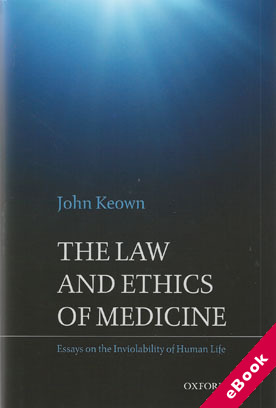
The Law and Ethics of Medicine: Essays on the Inviolability of Human Life explains the principle of the inviolability of human life and its continuing relevance to English law governing aspects of medical practice at the beginning and end of life.
The book shows that the principle, though widely recognized as an historic and foundational principle of the common law, has been misunderstood in the legal academy, at the Bar and on the Bench.
Part I of the book identifies the confusion and clarifies the principle, distinguishing it from 'vitalism' on the one hand and a 'qualitative' evaluation of human life on the other.
Part II addresses legal aspects of the beginning of life, including the history of the law against abortion and its relevance to the ongoing abortion debate in the US; the law relating to the 'morning after' pill; and the legal status of the human embryo in vitro.
Part III addresses legal aspects of the end of life, including the euthanasia debate; the withdrawal of tube-feeding from patients in a 'persistent vegetative state'; and the duty to provide palliative treatment.
This unique collection of essays offers a much-needed clarification of a cardinal legal and ethical principle and should be of interest to lawyers, bioethicists, and healthcare professionals (whether they subscribe to the principle or not) in all common law jurisdictions and beyond.











