
The eBooks we sell are sold as a single-user licence and are intended for the end user only.
The sale of some eBooks are restricted to certain countries. To alert you to such restrictions, please select the country of the billing address of your credit or debit card you wish to use for payment.
For further information see https://www.wildy.com/ebook-formats
Once the order is confirmed an e-mail will be sent to you to allow you to download the eBook. For UK purchases this will be automatic. For purchases outside the UK a member of staff will need to confirm the sale. (Staff are available to do this during normal business hours, Mon-Fri 8:30-17:00 UK time)
All eBooks are supplied firm sale and cannot be returned. If you believe there is a fault with your eBook then contact us on ebooks@wildy.com and we will help in resolving the issue. This does not affect your statutory rights.
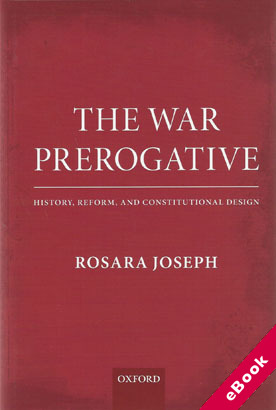
This book studies the evolution of the war prerogative in England from 1600-2012. It traces the historical theory and practice of the war prerogative and proposes reform of the constitutional arrangements for its exercise.
It addresses three key questions. First, what have writers on political and constitutional theory said about the constitutional arrangements for the war prerogative, and, in particular, what justifications have been advanced for those arrangements?
Secondly, in practice, has the executive in fact possessed sole and exclusive powers over war and the deployment of force, or have Parliament and the courts had a role to play in their exercise and scrutiny? Thirdly, are there better ways to organise our constitutional arrangements for the war prerogative, to enable a more substantive role for Parliament (particularly the House of Commons) in its exercise and scrutiny?
On the first question, it is shown that orthodox theoretical and political discourses have continuously asserted the executive's exclusive power over war, but the justifications advanced for that arrangement have changed over time. Those changes reflect the varying influence of different political theories at different times. On the second question, it is found that, contrary to orthodox theoretical and political discourses, Parliament has played an active and substantive role in the exercise and scrutiny of the war prerogative.
The courts have refused to intervene in the exercise of the war prerogative, but have been more ready to intervene in cases involving the exercise of powers incidental to the war prerogative. On the third question, it is argued that reform of the constitutional arrangements for the war prerogative is necessary and desirable. The use of 'institutional mechanisms' is recommended, which are small-scale rules and institutional arrangements, within existing institutions, which aim to promote certain normative goals.
In particular, the enactment of a statute is proposed, which would impose conditions on the executive's exercise of its war prerogative. It is argued that these proposals show that, through careful institutional design, democratic values, national security, and operational efficiency can each be reconciled and promoted.










