
The eBooks we sell are sold as a single-user licence and are intended for the end user only.
The sale of some eBooks are restricted to certain countries. To alert you to such restrictions, please select the country of the billing address of your credit or debit card you wish to use for payment.
For further information see https://www.wildy.com/ebook-formats
Once the order is confirmed an e-mail will be sent to you to allow you to download the eBook. For UK purchases this will be automatic. For purchases outside the UK a member of staff will need to confirm the sale. (Staff are available to do this during normal business hours, Mon-Fri 8:30-17:00 UK time)
All eBooks are supplied firm sale and cannot be returned. If you believe there is a fault with your eBook then contact us on ebooks@wildy.com and we will help in resolving the issue. This does not affect your statutory rights.
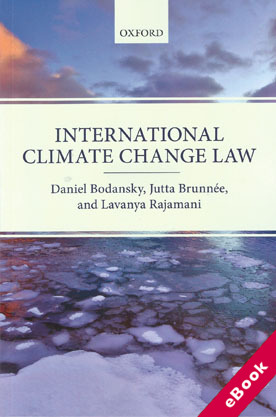
This textbook, by three experts in the field, provides a comprehensive overview of the legal instruments and sources that govern the international response to climate change.
Climate change is one of the fundamental challenges facing the world today, and is the cause of signficiant international concern. In response, states have created a legal regime, albeit a contested one, to address climate change and its impacts. The legal texts that comprise the climate regime - the United Nations Framework Convention on Climate Change, 1992, and its Kyoto Protocol, 1997 - are in force, have concrete content, and are binding.
Resources are in place to facilitate the negotiation process, incentivise emissions reductions, and supervise and enforce compliance with the obligations imposed by these treaties. However, the language used in these international instruments is frequently intentionally vague. This book provides a clear guide to the legal regime applicable to climate change, demonstrating how the terms employed in the relevant instruments and conventions should be interpreted.
The book begins by locating international climate change law within the broader context of international law and international environmental law. It considers the evolution of the international climate change regime, and the process of law-making that has led to it. It examines the key provisions of the Framework Convention and the Kyoto Protocol.
It then analyses the principles that form part of the conceptual underpinning of the climate regime, as well as the elaborate institutional and governance architecture that has been created at successive international conferences. This assessment of the contours of the current regime is followed by a chapter devoted to the design of the post-2012 climate change regime, and trends indicated by the climate negotiations.
The final two chapters address the relationship of international climate change law to regional and national climate change law, as well as its relationship with other areas of international regulation. This book is an essential introduction for any student and scholar needing to know more about international climate change law.










