
The eBooks we sell are sold as a single-user licence and are intended for the end user only.
The sale of some eBooks are restricted to certain countries. To alert you to such restrictions, please select the country of the billing address of your credit or debit card you wish to use for payment.
For further information see https://www.wildy.com/ebook-formats
Once the order is confirmed an e-mail will be sent to you to allow you to download the eBook. For UK purchases this will be automatic. For purchases outside the UK a member of staff will need to confirm the sale. (Staff are available to do this during normal business hours, Mon-Fri 8:30-17:00 UK time)
All eBooks are supplied firm sale and cannot be returned. If you believe there is a fault with your eBook then contact us on ebooks@wildy.com and we will help in resolving the issue. This does not affect your statutory rights.
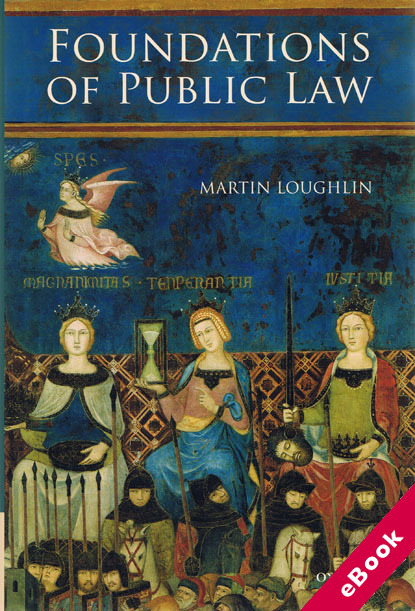
Foundations of Public Lawoffers a distinctive, provocative theory of public law, building on the views first outlined in The Idea of Public Law (OUP, 2003).
The theory aims to identify the essential character of public law, explain its particular modes of operation, and specify its unique task. Public law is conceived broadly as a type of law that comes into existence as a consequence of the secularization, rationalization and positivization of the medieval idea of fundamental law. Formed as a result of the changes that give birth to the modern state, public law establishes the authority and legitimacy of modern governmental ordering.
Public law today is a universal phenomenon, but its origins are European. Part I of the book examines the conditions of its formation, showing how much the concept borrowed from the refined debates of medieval jurists. Part II then examines the nature of public law.
Drawing on a line of juristic inquiry that developed from the late-sixteenth to the early nineteenth centuries - extending from Bodin, Althusius, Lipsius, Grotius, Hobbes, Spinoza, Locke and Pufendorf to the later works of Montesquieu, Rousseau, Kant, Fichte, Smith and Hegel - it presents an account of public law as a special type of political reason.
The remaining three Parts unpack the core elements of this concept: state, constitution, and government. By taking this broad approach to the subject, Professor Loughlin shows how, rather than being viewed as a limitation on power, law is better conceived as a means by which public power is generated. And by explaining the way that these core elements of state, constitution and government were shaped respectively by the technological, bourgeois, and disciplinary revolutions of the 16th-19th centuries, he reveals a concept of public law of considerable ambiguity, complexity and resilience.










