
The eBooks we sell are sold as a single-user licence and are intended for the end user only.
The sale of some eBooks are restricted to certain countries. To alert you to such restrictions, please select the country of the billing address of your credit or debit card you wish to use for payment.
For further information see https://www.wildy.com/ebook-formats
Once the order is confirmed an e-mail will be sent to you to allow you to download the eBook. For UK purchases this will be automatic. For purchases outside the UK a member of staff will need to confirm the sale. (Staff are available to do this during normal business hours, Mon-Fri 8:30-17:00 UK time)
All eBooks are supplied firm sale and cannot be returned. If you believe there is a fault with your eBook then contact us on ebooks@wildy.com and we will help in resolving the issue. This does not affect your statutory rights.
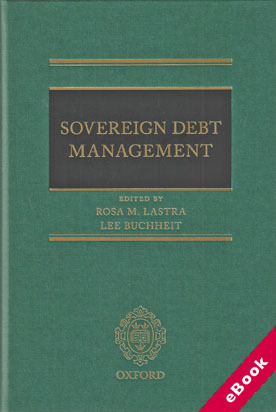
Sovereign debt is a complex and highly topical area of law and this work represents a new main reference book on the subject bringing together contributions from world leading practitioners, scholars and regulators.
Divided into five parts the book opens with a part on restructuring which analyses contractual provisions and the role of institutions such as the International Monetary Fund. The second part, on enforcement, considers the position of a sovereign as a defendant analyzing the availability of special immunities and matters of defense and arbitration pertinent to sovereign debt.
Part three of the book is concerned with complicating factors such as economic, political or banking crises and how these relate and complicate the task of addressing an unsustainable sovereign debt stock. In this section the particular and topical issues concerned with restructuring in a monetary union are explained. The fourth part provides economists' explanations of why and how sovereigns borrow and the causes of a sovereign debt, which enriches understanding by providing context to the purely legal aspects of the work.
The book closes with a section which covers proposed reform to sovereign debt systems. Dedicated to the leading expert Lee Buchheit, this work contains comprehensive and rigorous analysis on sovereign debt management which no specialist should be without.










