
The eBooks we sell are sold as a single-user licence and are intended for the end user only.
The sale of some eBooks are restricted to certain countries. To alert you to such restrictions, please select the country of the billing address of your credit or debit card you wish to use for payment.
For further information see https://www.wildy.com/ebook-formats
Once the order is confirmed an e-mail will be sent to you to allow you to download the eBook. For UK purchases this will be automatic. For purchases outside the UK a member of staff will need to confirm the sale. (Staff are available to do this during normal business hours, Mon-Fri 8:30-17:00 UK time)
All eBooks are supplied firm sale and cannot be returned. If you believe there is a fault with your eBook then contact us on ebooks@wildy.com and we will help in resolving the issue. This does not affect your statutory rights.
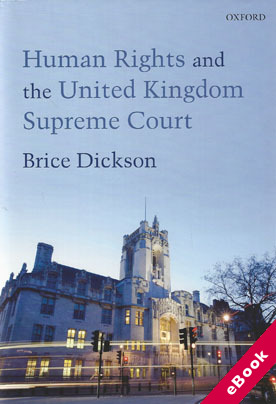
How does the UK Supreme Court approach human rights law? This book presents the first comprehensive overview of the human rights jurisprudence of the Court, analysing the opinions expressed by the current Justices and their predecessors, both judicially and extra-judicially.
It criticizes the judges for not developing the common law in a way which supplements the Human Rights Act, for not making imaginative enough use of that Act, and for adopting an attitude to Convention rights which is often out of step with the jurisprudence of the European Court of Human Rights in Strasbourg.
After setting the scene by explaining the constraints which are placed on the Supreme Court Justices, the book considers how human rights are conceptualized by the Court in general and how in particular the procedural questions thrown up by the Human Rights Act have been dealt with so far.
It then examines on a right-by-right basis the Justices' position on all the Convention rights and those additional international human rights standards which have been incorporated into UK law. Focusing on the views expressed by individual judges, the book details the many differences of opinion which have come to light and characterizes the prevailing positions, before attempting to predict what stance may be adopted in future on new issues.
The book offers an invaluable resource for any practitioners bringing human rights cases before the Court, and its critical arguments on the state of UK human rights law will be essential reading for all academics working in European human rights law.










