
The eBooks we sell are sold as a single-user licence and are intended for the end user only.
The sale of some eBooks are restricted to certain countries. To alert you to such restrictions, please select the country of the billing address of your credit or debit card you wish to use for payment.
For further information see https://www.wildy.com/ebook-formats
Once the order is confirmed an e-mail will be sent to you to allow you to download the eBook. For UK purchases this will be automatic. For purchases outside the UK a member of staff will need to confirm the sale. (Staff are available to do this during normal business hours, Mon-Fri 8:30-17:00 UK time)
All eBooks are supplied firm sale and cannot be returned. If you believe there is a fault with your eBook then contact us on ebooks@wildy.com and we will help in resolving the issue. This does not affect your statutory rights.
The regulation of sovereign financing is a highly topical and significant issue, in the light of continuing global financial turmoil.
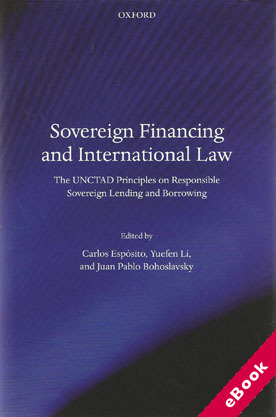
This book assesses the role of international law in sovereign financing, addressing this issue from both legal and economic standpoints. It takes as a starting point the recent report 'Principles on Responsible Sovereign Lending and Borrowing' by the United Nations Conference on Trade and Development (UNCTAD).
This report was endorsed by the United Nations General Assembly in its December 2011 Resolution on Debt, which emphasized the need for creditors and debtors to share responsibility for preventing unsustainable debt situations and encouraged all stakeholders to pursue the ongoing discussions within the framework of the UNCTAD Initiative.
Investigating the legal and economic basis for the principles which were articulated in the report, the book develops a detailed and nuanced analysis of the controversial and complex issues they raise, including those concerning finance and credit rating agencies, contingent liabilities, debt management, corruption, fiduciary relations and duties, Collective Action Clauses, and the role of the EU and UN.
Ultimately, it argues that the principles elaborated in the report correspond with general principles of international law, which provide a strong, pre-existing foundation upon which to build responsible principles for sovereign financing.











