
The eBooks we sell are sold as a single-user licence and are intended for the end user only.
The sale of some eBooks are restricted to certain countries. To alert you to such restrictions, please select the country of the billing address of your credit or debit card you wish to use for payment.
For further information see https://www.wildy.com/ebook-formats
Once the order is confirmed an e-mail will be sent to you to allow you to download the eBook. For UK purchases this will be automatic. For purchases outside the UK a member of staff will need to confirm the sale. (Staff are available to do this during normal business hours, Mon-Fri 8:30-17:00 UK time)
All eBooks are supplied firm sale and cannot be returned. If you believe there is a fault with your eBook then contact us on ebooks@wildy.com and we will help in resolving the issue. This does not affect your statutory rights.
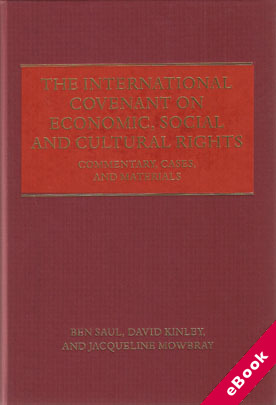
This book brings together all essential documents, materials, and case law relating to the International Covenant on Economic, Social and Cultural Rights (ICESCR) and its Optional Protocol, one of the most important human rights instruments in international law.
This book presents extracts from primary material alongside commentary and analysis, placing the documents in their wider context and situating economic, social, and cultural rights within the broader human rights framework. There is increasing interest internationally, regionally, and in domestic legal systems in the protection of economic, social, and cultural rights.
The Optional Protocol of 2008 allowed for individual communications to be made to the UN Committee on Economic, Social and Cultural Rights for the first time. At the regional level, socio-economic rights are well embedded in human rights systems in Europe and Africa. At the national level, constitutions and courts have increasingly regarded socio-economic rights as justiciable, narrowing the traditional divide with civil and political rights.
This book contextualises these developments within the role and impact of the ICESCR, and assesses the nature of those rights which are outside the Convention, such as the right to water, the rights of indigenous peoples, the right to development, and rights to peace and security.
Providing detailed analysis of the ICESCR structured around its articles, drawing on national as well as international case law and materials, and containing all of the key primary materials in its extensive appendices, this book is ideal for the judiciary, human rights practitioners, human rights activists, government institutions, academics, and students alike.











