
The eBooks we sell are sold as a single-user licence and are intended for the end user only.
The sale of some eBooks are restricted to certain countries. To alert you to such restrictions, please select the country of the billing address of your credit or debit card you wish to use for payment.
For further information see https://www.wildy.com/ebook-formats
Once the order is confirmed an e-mail will be sent to you to allow you to download the eBook. For UK purchases this will be automatic. For purchases outside the UK a member of staff will need to confirm the sale. (Staff are available to do this during normal business hours, Mon-Fri 8:30-17:00 UK time)
All eBooks are supplied firm sale and cannot be returned. If you believe there is a fault with your eBook then contact us on ebooks@wildy.com and we will help in resolving the issue. This does not affect your statutory rights.
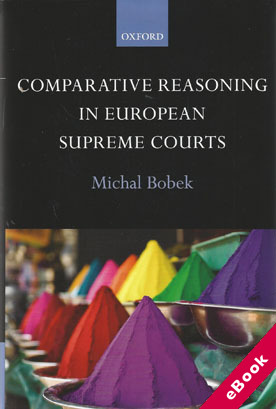
The last two decades have witnessed an exponential growth in debates on the use of foreign law by courts. Different labels have been attached to the same phenomenon: judges drawing inspiration from outside of their national legal systems for solving purely domestic disputes.
By doing so, the judges are said to engage in cross-border judicial dialogues. They are creating a larger, transnational community of judges. This book puts similar claims to test in relation to highest national jurisdictions (supreme and constitutional courts) in Europe today. How often and why do judges choose to draw inspiration from foreign materials in solving domestic cases?
The book addresses these questions from both an empirical and a theoretical angle. Empirically, the genuine use of comparative arguments by national highest courts in five European jurisdictions is examined: England and Wales, France, Germany, the Czech Republic, and Slovakia. On the basis of comparative discussion of the practice and its national theoretical underpinning in these and partially also in other European systems, an overreaching theoretical framework for the current judicial use of comparative arguments is developed.
Drawing on the author's own past judicial experience in a national supreme court, this book is a critical account of judicial engagement with foreign authority in Europe today. The sober middle ground inductively conceptualized and presented in this book provides solid jurisprudential foundations for the ongoing use of comparative arguments by courts as well as its further scholarly discussion.










