The eBooks we sell are sold as a single-user licence and are intended for the end user only.
The sale of some eBooks are restricted to certain countries. To alert you to such restrictions, please select the country of the billing address of your credit or debit card you wish to use for payment.
For further information see https://www.wildy.com/ebook-formats
Once the order is confirmed an e-mail will be sent to you to allow you to download the eBook. For UK purchases this will be automatic. For purchases outside the UK a member of staff will need to confirm the sale. (Staff are available to do this during normal business hours, Mon-Fri 8:30-17:00 UK time)
All eBooks are supplied firm sale and cannot be returned. If you believe there is a fault with your eBook then contact us on ebooks@wildy.com and we will help in resolving the issue. This does not affect your statutory rights.
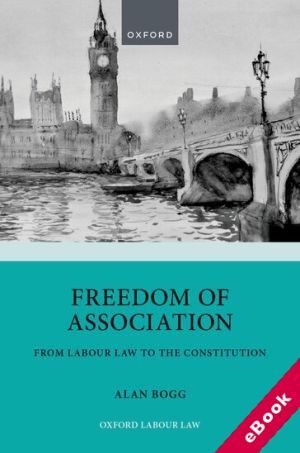
Freedom of association for workers and trade unions lies at the centre of labour law. Traditionally, trade union rights were structured through detailed labour codes governing organisation, collective bargaining, and the right to strike, with limited involvement from ordinary courts. This insulated labour law from common law principles and supported a mid-20th-century model built on assumptions of industrial equilibrium and political consensus. However, over the past five decades, deregulation and the erosion of collective bargaining have pushed workers and unions toward constitutional claims based on freedom of association to challenge restrictive labour laws.
This monograph explores the evolving encounter between labour law and human rights law in this domain. Focusing on the UK, the European Convention on Human Rights, and Canada, it analyses conflicts among employers, governments, and trade unions as courts increasingly adjudicate freedom-of-association claims. The book identifies a consistent judicial pattern distinguishing between the "individual" and "collective" dimensions of the right. In individual cases—such as victimisation by employers or unions-courts intervene to protect workers' equal moral standing, reflecting principles of equality before the law and non-discrimination. In collective cases—such as determining bargaining agents or the procedural rules governing strikes-courts generally defer to legislatures to preserve democratic autonomy in industrial relations.
Drawing on legal history and controversies surrounding trade union membership, collective bargaining, strikes, and the closed shop, the book defends a model of freedom of association that upholds both the dignity of workers and the structural autonomy of labour law.