
The eBooks we sell are sold as a single-user licence and are intended for the end user only.
The sale of some eBooks are restricted to certain countries. To alert you to such restrictions, please select the country of the billing address of your credit or debit card you wish to use for payment.
For further information see https://www.wildy.com/ebook-formats
Once the order is confirmed an e-mail will be sent to you to allow you to download the eBook. For UK purchases this will be automatic. For purchases outside the UK a member of staff will need to confirm the sale. (Staff are available to do this during normal business hours, Mon-Fri 8:30-17:00 UK time)
All eBooks are supplied firm sale and cannot be returned. If you believe there is a fault with your eBook then contact us on ebooks@wildy.com and we will help in resolving the issue. This does not affect your statutory rights.
Moral rights are held by authors and artists under copyright laws around the world and serve to recognize their role and rights as creators.
In the technological context, these rights have acquired a new importance. Moral rights respond to a growing public need for the integrity of knowledge, while providing much-needed support in the struggle against copyright piracy. Crucially, they affirm the basic human dignity of authors and artists everywhere. They offer the potential for new approaches to copyright conflicts - for harmonizing public and private interests, commercial and cultural priorities, copyright and Copyleft, through a time-tested and universally relevant idea.
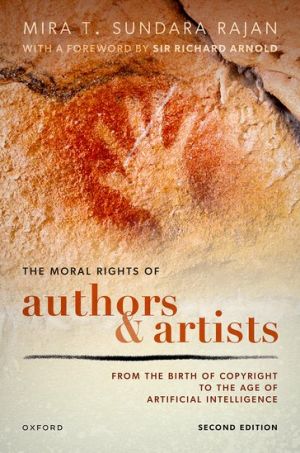
Moral Rights of Authors and Artists: From the Birth of Copyright to the Age of Artificial Intelligence tells the story of moral rights as the idea developed through the ages, from their antecedents in Asia and Europe to their modern emergence in British and European copyright laws, and their recent, reluctant yet powerful acceptance in the United States. It paints an unparalleled comparative picture of copyright law, reaching from North America to Australia and New Zealand, India, Japan, Korea, and all across Continental Europe - drawn from the author's rich international experience, and her practical insights as an author and artist herself. Above all, this book explores the unprecedented relevance of moral rights in the age of artificial intelligence, where they can help to affirm the importance of human creativity at its most vulnerable. It is a powerful work of illumination and advocacy.










