
The eBooks we sell are sold as a single-user licence and are intended for the end user only.
The sale of some eBooks are restricted to certain countries. To alert you to such restrictions, please select the country of the billing address of your credit or debit card you wish to use for payment.
For further information see https://www.wildy.com/ebook-formats
Once the order is confirmed an e-mail will be sent to you to allow you to download the eBook. For UK purchases this will be automatic. For purchases outside the UK a member of staff will need to confirm the sale. (Staff are available to do this during normal business hours, Mon-Fri 8:30-17:00 UK time)
All eBooks are supplied firm sale and cannot be returned. If you believe there is a fault with your eBook then contact us on ebooks@wildy.com and we will help in resolving the issue. This does not affect your statutory rights.
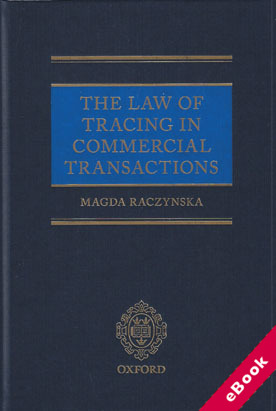
A pressing problem often facing commercial practitioners is how to determine the principle which would dictate when a proprietary claim is available and when it is not.
This book explains the nature and structure of key interests in property in commercial transactions and analyses the incidence of proprietary claims available to holders of different interests in assets.
The book starts by identifying the structure of those interests which the author terms "lesser proprietary interests", comprising security interests and interests based on retention of title in contracts of sale of goods, hire-purchase agreements, and leases, thereby contributing to the understanding of concepts which are traditionally used to explain this area of law such as bailment and fiduciary relationship.
Using this framework, the book examines the circumstances in which the interests are lost and the extent to which proprietary claims can be asserted in assets that derive from the original subject matter, that is proceeds, products and income, as well as in accretions.
It examines these claims at three levels: first, as a matter of default rules in the absence of misappropriation of the original subject matter; secondly, as a matter of contract, considering the limits of contractual freedom; and thirdly, in circumstances in which the original subject matter has been misappropriated.
This book is the first to approach the topic of tracing and derived assets in commercial transactions on a principled basis. It subjects an area of little authority and general academic comment to rigorous and detailed analysis. It contains treatment of the relevant case law and discussion of points that have yet to come up in litigation in England and abroad. By way of comparison, it considers salient aspects of the relevant rules under Article 9 of the US Uniform Commercial Code.
The book is timely in light of the current debate on the shape of the law reform of secured transactions in England and elsewhere.










