
The eBooks we sell are sold as a single-user licence and are intended for the end user only.
The sale of some eBooks are restricted to certain countries. To alert you to such restrictions, please select the country of the billing address of your credit or debit card you wish to use for payment.
For further information see https://www.wildy.com/ebook-formats
Once the order is confirmed an e-mail will be sent to you to allow you to download the eBook. For UK purchases this will be automatic. For purchases outside the UK a member of staff will need to confirm the sale. (Staff are available to do this during normal business hours, Mon-Fri 8:30-17:00 UK time)
All eBooks are supplied firm sale and cannot be returned. If you believe there is a fault with your eBook then contact us on ebooks@wildy.com and we will help in resolving the issue. This does not affect your statutory rights.
The 2012 Criminal Injuries Compensation Scheme (CICS) deals with some 33,000 applications for compensation each year.
It has, since 1964, been one of the principal means by which the state aims to meet victims' expectations following an offence of violence, but it also displays a clear doctrinal effort to differentiate 'deserving' from 'undeserving' victims. Over much of the same period criminal courts and agencies have enjoyed powers to order offenders to pay compensation to their victims, most recently as an element of restorative justice.
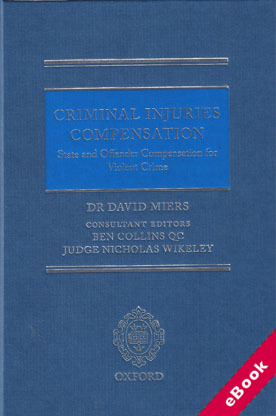
Split into two parts, Criminal Injuries Compensation is an authoritative analysis of the statutory provisions governing these various remedies. Part One, State Compensation, analyses the Scheme's defining provisions: what constitutes 'a criminal injury', what persons and injuries may be compensated, the rules governing the victim's own conduct and character, the assessment of the award, and the procedures governing applications, appeals and judicial review.
Part Two, Offender Compensation, analyses the conditions under which a criminal court may make a compensation order as an element of its sentencing decision, concluding with the potential of restorative justice to deliver offender compensation to victims. The book also touches on the wider political and criminal justice context of compensation.
Written and edited by an expert academic and practitioner team, Criminal Injuries Compensation is an essential text for all those with an interest in understanding the statutory, judicial and administrative rules that govern state and offender payment of compensation to victims of violent crime.











