
The eBooks we sell are sold as a single-user licence and are intended for the end user only.
The sale of some eBooks are restricted to certain countries. To alert you to such restrictions, please select the country of the billing address of your credit or debit card you wish to use for payment.
For further information see https://www.wildy.com/ebook-formats
Once the order is confirmed an e-mail will be sent to you to allow you to download the eBook. For UK purchases this will be automatic. For purchases outside the UK a member of staff will need to confirm the sale. (Staff are available to do this during normal business hours, Mon-Fri 8:30-17:00 UK time)
All eBooks are supplied firm sale and cannot be returned. If you believe there is a fault with your eBook then contact us on ebooks@wildy.com and we will help in resolving the issue. This does not affect your statutory rights.
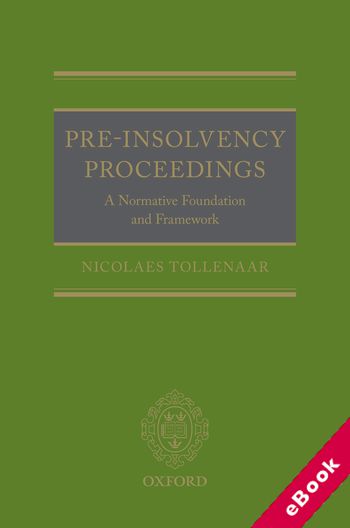
This timely new work evaluates the law regarding pre-insolvency proceedings. Setting the law in context, the book provides a conceptual framework for ideal practice, illustrating the implications of the new regime with specific practical examples.
The book features a comprehensive discussion of the key principles underlying restructuring proceedings and explains the purpose of, and justification for, pre-insolvency proceedings. It provides answers to a number of important issues that are still undecided and the subject of debate.
In particular, the book provides detailed analysis of the system of voting in classes, and it offers an in-depth discussion of the appropriate criteria for confirmation and cram-down together with consideration of the little-understood underlying economic issues. It also includes analysis of the key aspects of valuation and the applicable valuation standards in the context of restructuring, much needed as the incidence of judicial valuation arises in the context of cram-down.
A comparative analysis and critique of UK schemes of arrangement and US Chapter 11 procedure is also included, giving readers a good understanding of the key features of both systems and enabling them to identify and learn from the differences. The author also proposes an outline of ideal pre-insolvency proceedings, setting out general and specific requirements for ensuring flexibility, efficiency, and effectiveness.










