
The eBooks we sell are sold as a single-user licence and are intended for the end user only.
The sale of some eBooks are restricted to certain countries. To alert you to such restrictions, please select the country of the billing address of your credit or debit card you wish to use for payment.
For further information see https://www.wildy.com/ebook-formats
Once the order is confirmed an e-mail will be sent to you to allow you to download the eBook. For UK purchases this will be automatic. For purchases outside the UK a member of staff will need to confirm the sale. (Staff are available to do this during normal business hours, Mon-Fri 8:30-17:00 UK time)
All eBooks are supplied firm sale and cannot be returned. If you believe there is a fault with your eBook then contact us on ebooks@wildy.com and we will help in resolving the issue. This does not affect your statutory rights.
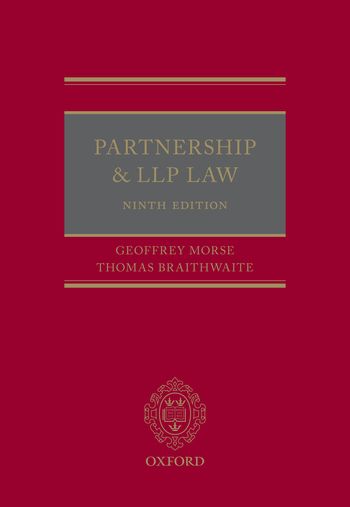
This book details the principles of the current law on partnerships, limited partnerships, and limited liability partnerships in an accessible form. It details the formation and nature of partnership including the interface between partners and employees, workers, and creditors in a partnership context. It then looks at how partnership interacts with public regulations. Next it sets out the position regarding contracts and other transactions involving a partnership, followed by consideration of the relationship between partners, including partnership property. Dissolution of, and exiting from, a solvent partnership, precede a chapter on insolvency either of a partner or the firm. Limited partnerships, including the new form, Private Fund Limited Partnerships, are detailed, highlighting the differences from partnerships.
For this new edition, the coverage of limited liability partnerships has been fully revised and expanded. After setting out the background to the legislation and explaining its structure, the book examines the requirements for the creation of LLPs, how they are incorporated, and the consequences of their incorporation as separate legal entities. It explores what membership of an LLP entails, including the interrelation of membership with employment and worker status, and the relations between members and the LLP and between the members themselves. It then looks at the default provisions, the role of the LLP Agreement, and the extent to which contractual doctrines such as repudiation and frustration apply to that agreement. Finally, the book looks at decision-making within an LLP, termination of a member's membership, and insolvency and dissolution of the LLP itself.










