
The eBooks we sell are sold as a single-user licence and are intended for the end user only.
The sale of some eBooks are restricted to certain countries. To alert you to such restrictions, please select the country of the billing address of your credit or debit card you wish to use for payment.
For further information see https://www.wildy.com/ebook-formats
Once the order is confirmed an e-mail will be sent to you to allow you to download the eBook. For UK purchases this will be automatic. For purchases outside the UK a member of staff will need to confirm the sale. (Staff are available to do this during normal business hours, Mon-Fri 8:30-17:00 UK time)
All eBooks are supplied firm sale and cannot be returned. If you believe there is a fault with your eBook then contact us on ebooks@wildy.com and we will help in resolving the issue. This does not affect your statutory rights.
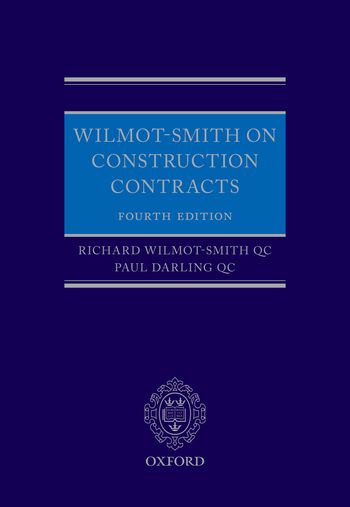
The fourth edition of Wilmot Smith on Construction Contracts continues to take a clear and practical approach to the law and practice relating to construction contracts in the UK. It provides comprehensive coverage of the substantive law and modern dispute resolution procedures in the field of construction and gives clear guidance when seeking difficult answers.
Paul Darling Q.C. has joined Richard Wilmot-Smith Q.C. as co-editor. Together they have updated, refined and extended the work's coverage. The author team includes new and high-profile practitioners in the field of international arbitration (including Peter Rees Q.C. and David Bateson) and ADR (with Edwin Glasgow Q.C. joining Marion Smith Q.C. in re-casting the chapter on mediation). David Sawtell has considerably re-cast the chapter on adjudication. The law on extra contractual claims (unjust enrichment) has been substantively revised and updated by a leading expert on unjust enrichment.
The work provides key practical tips including: where and when you issue proceedings; what the judges will expect and their preferences; and how trials can be made shorter. A separate section analyses enforcement of adjudicators' awards, covering recent case law on this area. This is carefully examined and digested in detail to ensure the reader has an understanding of the pitfalls of enforcement.
Richard Wilmot-Smith QC and Paul Darling QC ensure that the work continues to provide an essential source of reference on this area of the law. Their practical approach and reliance on clear exposition is prevalent throughout this book, and it is allied with deep scholarship to secure its position as a definitive work on construction law.











