
The eBooks we sell are sold as a single-user licence and are intended for the end user only.
The sale of some eBooks are restricted to certain countries. To alert you to such restrictions, please select the country of the billing address of your credit or debit card you wish to use for payment.
For further information see https://www.wildy.com/ebook-formats
Once the order is confirmed an e-mail will be sent to you to allow you to download the eBook. For UK purchases this will be automatic. For purchases outside the UK a member of staff will need to confirm the sale. (Staff are available to do this during normal business hours, Mon-Fri 8:30-17:00 UK time)
All eBooks are supplied firm sale and cannot be returned. If you believe there is a fault with your eBook then contact us on ebooks@wildy.com and we will help in resolving the issue. This does not affect your statutory rights.
From the Master and Servant legislation to the Factories Acts of the 19th century, the criminal law has always had a vital yet normatively complex role in the regulation of work relations. Even in its earliest forms, it operated both as a tool to repress collective organizations and enforce labour discipline, while policing the worst excesses of industrial capitalism. Recently, governments have begun to rediscover criminal law as a regulatory tool in a diverse set of areas related to labour law: 'modern slavery', penalizing irregular migrants, licensing regimes for labour market intermediaries, wage theft, supporting the enforcement of general labour standards, new forms of hybrid preventive orders, harassment at work, and industrial protest.
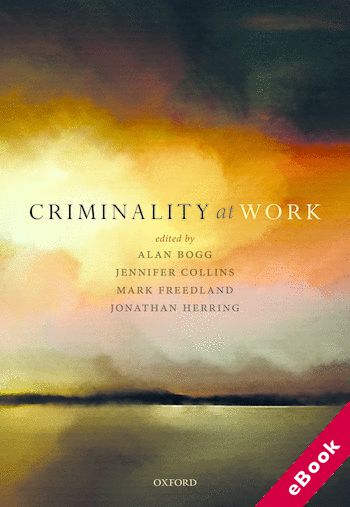
This volume explores the political and regulatory dimensions of the new 'criminality at work' from a wide range of disciplinary perspectives, including labour law, immigration law, and health and safety regulations. The volume provides an overview of the regulatory terrain of 'criminality at work', exploring whether these different regulatory interventions represent politically legitimate uses of the criminal law. The book also examines whether these recent interventions constitute a new pattern of criminalization that operates in preventive mode and is based upon character and risk-based forms of culpability. The volume concludes by reflecting upon the general themes of 'criminality at work' comparatively, from Australian, Canadian, and US perspectives.
Criminality at Work is a timely, rich and ambitious piece of scholarship that examines the many intersections between criminal law and work relations from a historical and contemporary vantage-point.










