
The eBooks we sell are sold as a single-user licence and are intended for the end user only.
The sale of some eBooks are restricted to certain countries. To alert you to such restrictions, please select the country of the billing address of your credit or debit card you wish to use for payment.
For further information see https://www.wildy.com/ebook-formats
Once the order is confirmed an e-mail will be sent to you to allow you to download the eBook. For UK purchases this will be automatic. For purchases outside the UK a member of staff will need to confirm the sale. (Staff are available to do this during normal business hours, Mon-Fri 8:30-17:00 UK time)
All eBooks are supplied firm sale and cannot be returned. If you believe there is a fault with your eBook then contact us on ebooks@wildy.com and we will help in resolving the issue. This does not affect your statutory rights.
In enforcing EU competition law, the Commission employs a unique doctrine of parental antitrust liability: it imposes fines on the parent company of an infringing subsidiary in cases where the parent exercises decisive influence over the subsidiary's commercial policy. Critics of this contentious aspect of EU competition law believe that the doctrine is unfair, ineffective, obscure, disproportionate, contrary to due process, and based upon a dubious, if not extremely flimsy, justificatory foundation. Such criticism raises serious and unanswered questions about the legitimacy of the Commission's efforts to enforce competition law.
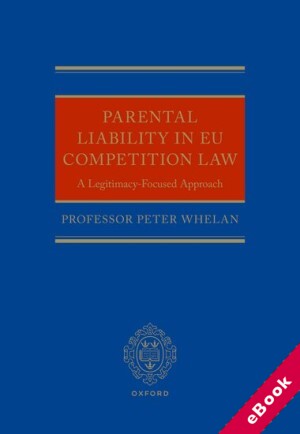
Parental Liability in EU Competition Law: A Legitimacy-Focused Approach is the first monograph to be dedicated to this controversial topic. Written by Professor Peter Whelan, the book contends that, although the general concept of parental liability can be justified in principle, the current EU-level doctrine of parental antitrust liability in fact suffers from a distinct and problematic lack of legitimacy. More specifically, the said doctrine displays significant deficiencies with respect to effectiveness, fairness, and legality.
Given this undesirable state of affairs, Parental Liability in EU Competition Law offers a fully-rationalised, reformulated approach to parental antitrust liability for EU competition law violations that is built around the notion of parental fault. That approach provides a solid normative account of how to impose parental antitrust liability in a manner that is theoretically robust, effective in practice, fair in substance, and legally sound.











