
The eBooks we sell are sold as a single-user licence and are intended for the end user only.
The sale of some eBooks are restricted to certain countries. To alert you to such restrictions, please select the country of the billing address of your credit or debit card you wish to use for payment.
For further information see https://www.wildy.com/ebook-formats
Once the order is confirmed an e-mail will be sent to you to allow you to download the eBook. For UK purchases this will be automatic. For purchases outside the UK a member of staff will need to confirm the sale. (Staff are available to do this during normal business hours, Mon-Fri 8:30-17:00 UK time)
All eBooks are supplied firm sale and cannot be returned. If you believe there is a fault with your eBook then contact us on ebooks@wildy.com and we will help in resolving the issue. This does not affect your statutory rights.
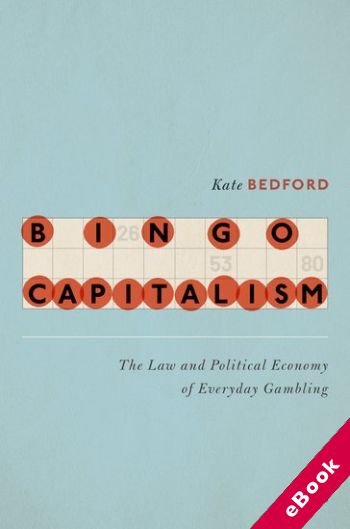
Casinos are often used by political economists, and popular commentators, to think critically about capitalism. Bingo - an equal chance numbers game played in many parts of the world - is overlooked in these conversations about gambling and political economy.
Bingo Capitalism challenges that omission by asking what bingo in England and Wales can teach us about capitalism and the regulation of everyday gambling economies. The book draws on official records of parliamentary debate, case law, regulations and in-depth interviews with both bingo players and workers to offer the first socio-legal account of this globally significant and immensely popular pastime.
It explores the legal and political history of bingo and how gender shapes, and is shaped by, diverse state rules on gambling. It also sheds light on the regulation of workers, players, products, places, and technologies. In so doing it adds a vital new dimension to accounts of UK gambling law and regulation.
Through Bingo Capitalism, Bedford makes a key theoretical contribution to our understanding of the relationship between gambling and political economy, showing the role of the state in supporting and then eclipsing environments where gambling played a key role as mutual aid. In centring the regulatory entanglement between vernacular play forms, self-organised membership activity, and corporate leisure experiences, she offers a fresh vision of gambling law from the everyday perspective of bingo.










