
The eBooks we sell are sold as a single-user licence and are intended for the end user only.
The sale of some eBooks are restricted to certain countries. To alert you to such restrictions, please select the country of the billing address of your credit or debit card you wish to use for payment.
For further information see https://www.wildy.com/ebook-formats
Once the order is confirmed an e-mail will be sent to you to allow you to download the eBook. For UK purchases this will be automatic. For purchases outside the UK a member of staff will need to confirm the sale. (Staff are available to do this during normal business hours, Mon-Fri 8:30-17:00 UK time)
All eBooks are supplied firm sale and cannot be returned. If you believe there is a fault with your eBook then contact us on ebooks@wildy.com and we will help in resolving the issue. This does not affect your statutory rights.
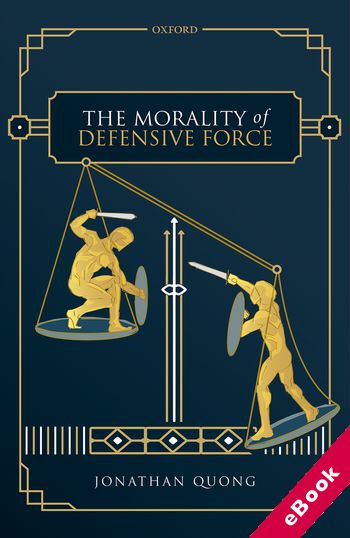
When is it morally permissible to engage in self-defense or the defense of others?
Jonathan Quong defends a variety of novel ideas in this book about the morality of defensive force, providing an original philosophical account of the central moral principles that should regulate its use. We cannot understand the morality of defensive force, he reasons, until we ask and answer deeper questions about how the use of defensive force fits with a more general account of justice and moral rights. In developing this stance, Quong presents new views on liability, proportionality, and necessity. He argues that self-defense can sometimes be justified on the basis of an agent-relative prerogative to give greater weight to one's own life and interests, contrary to the dominant view in the literature. Additionally Quong develops a novel conception of individual rights against harm. Unlike some, who believe that our rights against harm are fact-relative, he argues that our rights against being harmed by others must, in certain respects, be sensitive to the evidence that others can reasonably be expected to possess.
The book concludes with Quong's extended defense of the means principle, a principle that prohibits harmfully using other persons' bodies or other rightful property unless those persons are duty bound to permit this use or have otherwise waived their claims against such use.











