The eBooks we sell are sold as a single-user licence and are intended for the end user only.
The sale of some eBooks are restricted to certain countries. To alert you to such restrictions, please select the country of the billing address of your credit or debit card you wish to use for payment.
For further information see https://www.wildy.com/ebook-formats
Once the order is confirmed an e-mail will be sent to you to allow you to download the eBook. For UK purchases this will be automatic. For purchases outside the UK a member of staff will need to confirm the sale. (Staff are available to do this during normal business hours, Mon-Fri 8:30-17:00 UK time)
All eBooks are supplied firm sale and cannot be returned. If you believe there is a fault with your eBook then contact us on ebooks@wildy.com and we will help in resolving the issue. This does not affect your statutory rights.
Due to a technical issue some ebooks are not available to order.
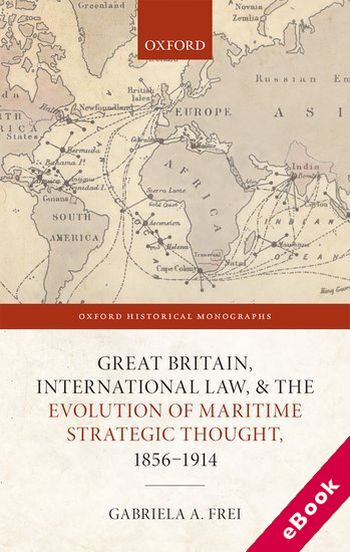
Gabriela A. Frei addresses the interaction between international maritime law and maritime strategy in a historical context, arguing that both international law and maritime strategy are based on long-term state interests. Great Britain as the predominant sea power in the nineteenth and early twentieth centuries shaped the relationship between international law and maritime strategy like no other power. This study explores how Great Britain used international maritime law as an instrument of foreign policy to protect its strategic and economic interests, and how maritime strategic thought evolved in parallel to the development of international legal norms.
Frei offers an analysis of British state practice as well as an examination of the efforts of the international community to codify international maritime law in the late nineteenth and early twentieth centuries. Great Britain as the predominant sea power as well as the world's largest carrier of goods had to balance its interests as both a belligerent and a neutral power. With the growing importance of international law in international politics, the volume examines the role of international lawyers, strategists, and government officials who shaped state practice. Great Britain's neutrality for most of the period between 1856 and 1914 influenced its state practice and its perceptions of a future maritime conflict. Yet, the codification of international maritime law at the Hague and London conferences at the beginning of the twentieth century demanded a reassessment of Great Britain's legal position.