
The eBooks we sell are sold as a single-user licence and are intended for the end user only.
The sale of some eBooks are restricted to certain countries. To alert you to such restrictions, please select the country of the billing address of your credit or debit card you wish to use for payment.
For further information see https://www.wildy.com/ebook-formats
Once the order is confirmed an e-mail will be sent to you to allow you to download the eBook. For UK purchases this will be automatic. For purchases outside the UK a member of staff will need to confirm the sale. (Staff are available to do this during normal business hours, Mon-Fri 8:30-17:00 UK time)
All eBooks are supplied firm sale and cannot be returned. If you believe there is a fault with your eBook then contact us on ebooks@wildy.com and we will help in resolving the issue. This does not affect your statutory rights.
Sexual assault law has been undergoing significant shifts around the world. Traditional criminal laws against sexual assault had a narrow scope: they targeted rape as coerced sexual intercourse, and they defined coercion as physical violence or threats with physical violence. Modern offense descriptions are tracing a change in the logic and structure of criminal laws against sexual assault from the offenders' violence to the victims' lack of consent as the key feature of criminal wrongdoing. However, there are clear and marked differences regarding the offence descriptions in substantive criminal laws in various jurisdictions.
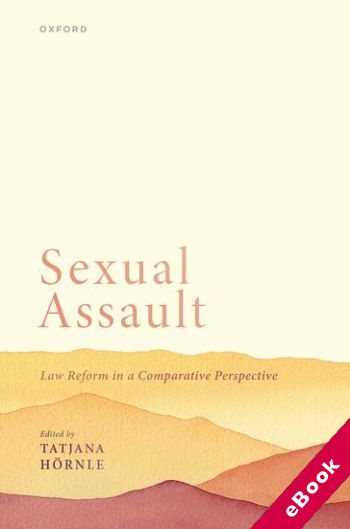
Sexual Assault: Law Reform in a Comparative Perspective provides an overview of the debates surrounding the concept and definition of sexual consent, comparing the context and content of law reform in six countries: Canada, England and Wales, Germany, Sweden, the U.S. (concentrating on the American Law Institute's Model Penal Code), and Spain. Leading scholars in the field also analyse the normative questions that arise once the notion of consent gains centre stage. The overall purpose is to assess whether the new generation of criminal prohibitions reflect coherent and convincing concepts of sexual autonomy and consent, and what could be considered the best models for future law reform.











