
The eBooks we sell are sold as a single-user licence and are intended for the end user only.
The sale of some eBooks are restricted to certain countries. To alert you to such restrictions, please select the country of the billing address of your credit or debit card you wish to use for payment.
For further information see https://www.wildy.com/ebook-formats
Once the order is confirmed an e-mail will be sent to you to allow you to download the eBook. For UK purchases this will be automatic. For purchases outside the UK a member of staff will need to confirm the sale. (Staff are available to do this during normal business hours, Mon-Fri 8:30-17:00 UK time)
All eBooks are supplied firm sale and cannot be returned. If you believe there is a fault with your eBook then contact us on ebooks@wildy.com and we will help in resolving the issue. This does not affect your statutory rights.
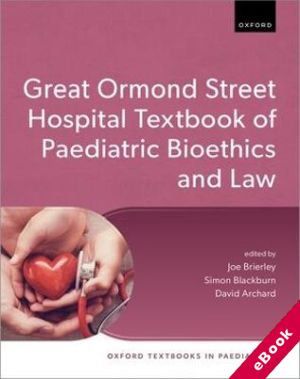
The Great Ormond Street Hospital Textbook of Paediatric Bioethics and Law is the first definitive reference to be produced by a world-leading children's hospital on the medical ethics and law applying to the care of children in a 21st century healthcare environment, exploring the challenges that children, their families, and those looking after them must face.
Healthcare professionals involved in the care of children are faced with controversies about decision-making, including genomics, personalised medicine, gene therapy, transplants, and the transfer of life-sustaining treatments from the ICU to the home. In addition, although patient safety and transparency are improving, recurrent high-profile worldwide institutional and individual failures have led to the need for mechanisms of external accountability and assessment. Open deliberation about the ethical issues increasingly faced in paediatrics and child health, backed by knowledge of the relevant law and considered together with children and their families, is the best solution for all these concerns.
This textbook enables better dialogue about the hard decisions made on a daily basis, considers how new and innovative treatments can be used in an ethical and lawful manner, and discusses when life sustaining therapy should be stopped, not started, or have limits set.










