
The eBooks we sell are sold as a single-user licence and are intended for the end user only.
The sale of some eBooks are restricted to certain countries. To alert you to such restrictions, please select the country of the billing address of your credit or debit card you wish to use for payment.
For further information see https://www.wildy.com/ebook-formats
Once the order is confirmed an e-mail will be sent to you to allow you to download the eBook. For UK purchases this will be automatic. For purchases outside the UK a member of staff will need to confirm the sale. (Staff are available to do this during normal business hours, Mon-Fri 8:30-17:00 UK time)
All eBooks are supplied firm sale and cannot be returned. If you believe there is a fault with your eBook then contact us on ebooks@wildy.com and we will help in resolving the issue. This does not affect your statutory rights.
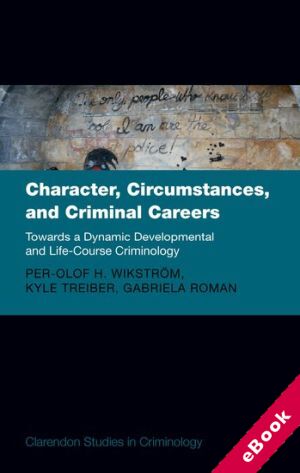
Why do young people engage in acts of crime and what is it that drives their criminal careers? These are the key questions addressed in Character, Circumstances, and Criminal Careers which explores and explains people's criminal careers through adolescence into young adulthood. Guided by Situational Action Theory (SAT)'s Developmental Ecological Action (DEA) model, the work analyses longitudinal data from the Peterborough Adolescent and Young Adult Development Study (PADS+), testing various hypotheses about the causes and drivers of people's crime involvement and criminal careers.
Character, Circumstances, and Criminal Careers makes an argument for a more dynamic Developmental and Life Course criminology (DLC) by theorising and exploring the relationship between individual characteristics and environmental features and their changes across adolescence and into young adulthood. The book considers whether childhood predictors, such as social disadvantage and social adversity, affect different trajectories of crime involvement. It also presents a special analysis of the age-crime curve and its explanation.
The book includes the most recent and updated statement of Situational Action Theory and its DEA model, including comparisons between the basic assumptions and propositions of SAT and selected major criminological theories (social bond and self-control theories, differential association and learning theories, rational choice theory and the theory of moral disengagement).
Character, Circumstances and Criminal Careers presents an original theory, a uniquely detailed contemporary longitudinal study, and novel research methods and analytical techniques, and applies these to derive innovative findings about the relationship between individual and environmental factors across a critical developmental period.










