
The eBooks we sell are sold as a single-user licence and are intended for the end user only.
The sale of some eBooks are restricted to certain countries. To alert you to such restrictions, please select the country of the billing address of your credit or debit card you wish to use for payment.
For further information see https://www.wildy.com/ebook-formats
Once the order is confirmed an e-mail will be sent to you to allow you to download the eBook. For UK purchases this will be automatic. For purchases outside the UK a member of staff will need to confirm the sale. (Staff are available to do this during normal business hours, Mon-Fri 8:30-17:00 UK time)
All eBooks are supplied firm sale and cannot be returned. If you believe there is a fault with your eBook then contact us on ebooks@wildy.com and we will help in resolving the issue. This does not affect your statutory rights.
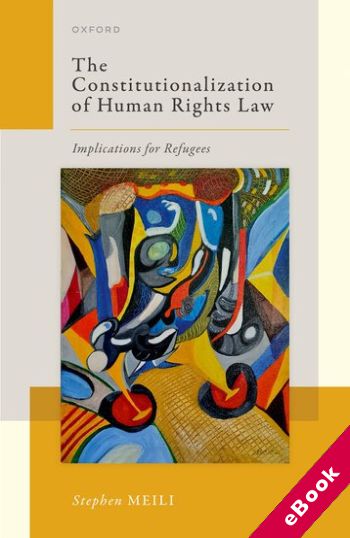
The Constitutionalization of Human Rights Law analyses how lawyers representing refugees use human rights provisions in national constitutions to close the gap between the Law and it's implementation. Focusing on five countries (Colombia, Mexico, South Africa, Uganda, the United States) the book examines how lawyers adapt creatively to social, political, and legal contexts. Many refugee-receiving states openly reject or passively ignore their obligation under international law to protect refugees. For this reason, cause lawyers (those who use the law to empower others) have turned to constitutionalized human rights law. While many countries likely included such provisions in their constitutions without intending to fulfil their commitments, cause lawyers have seized on them as a more enforceable means of rights protection.
This book theorizes a continuum of ever-more ambitious methods through which cause lawyers use constitutionalized human rights law to benefit refugees. Lawyers use different tools as they move along this continuum, including strategic litigation, training governmental officials in the applicable law, and various forms of informal advocacy. It makes important contributions to three strands of socio-legal literature. As to the effectiveness of human rights treaties, it provides qualitative evidence of how such treaties achieve greater significance when incorporated into national constitutions. As to refugee law, it analyses how international protections for refugees become stronger when domestic lawyers enforce them through national constitutions. And as to cause lawyering, it shows how refugee lawyers use constitutionalized human rights law to protect their clients.










