
The eBooks we sell are sold as a single-user licence and are intended for the end user only.
The sale of some eBooks are restricted to certain countries. To alert you to such restrictions, please select the country of the billing address of your credit or debit card you wish to use for payment.
For further information see https://www.wildy.com/ebook-formats
Once the order is confirmed an e-mail will be sent to you to allow you to download the eBook. For UK purchases this will be automatic. For purchases outside the UK a member of staff will need to confirm the sale. (Staff are available to do this during normal business hours, Mon-Fri 8:30-17:00 UK time)
All eBooks are supplied firm sale and cannot be returned. If you believe there is a fault with your eBook then contact us on ebooks@wildy.com and we will help in resolving the issue. This does not affect your statutory rights.
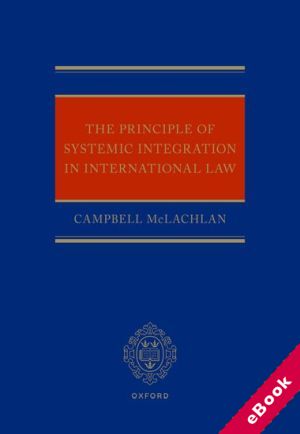
International law has greatly expanded in reach and density over the past few decades and its fragmented and decentralized nature is causing anxiety among those who need to resolve legal dilemmas in a system that lacks vertical hierarchy. Although the principle of systemic integration is embodied in Article 31(3)(c) of the Vienna Convention 1969, its operation and significance has not been fully assessed.
The Principle of Systemic Integration in International Law fills this research gap by analysing the manner in which the principle has been applied in the judicial decisions of international courts and tribunals, together with the practice of states and international organizations in the framing of international instruments and their application. Building upon the framework he first pioneered in 2005 and the culmination of two decades of academic research and practical experience in international law, the author Campbell McLachlan KC closely examines legislative texts and cases to reflect on the principle's theoretical foundations and actual application in practice.
The book argues that the principle of systemic integration contributes to an orderly framework within which conflicts between institutions and between legal norms may be addressed. It explores how disparate parts of international law are integrated in the development of bilateral and multilateral treaties and, finally, analyses the operation of the principle in international courts and tribunals. The reasoning and larger questions presented by the book will bring fresh insights to researchers and practitioners undertaking any international law project.










