
The eBooks we sell are sold as a single-user licence and are intended for the end user only.
The sale of some eBooks are restricted to certain countries. To alert you to such restrictions, please select the country of the billing address of your credit or debit card you wish to use for payment.
For further information see https://www.wildy.com/ebook-formats
Once the order is confirmed an e-mail will be sent to you to allow you to download the eBook. For UK purchases this will be automatic. For purchases outside the UK a member of staff will need to confirm the sale. (Staff are available to do this during normal business hours, Mon-Fri 8:30-17:00 UK time)
All eBooks are supplied firm sale and cannot be returned. If you believe there is a fault with your eBook then contact us on ebooks@wildy.com and we will help in resolving the issue. This does not affect your statutory rights.
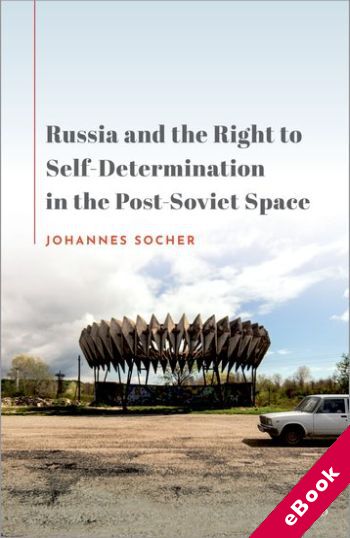
The right to self-determination is renowned for its lack of clear interpretation. Broadly speaking, one can differentiate between a 'classic' and a 'romantic' tradition. In modern international law, the balance between these two opposing traditions is sought in an attempt to contain or 'domesticate' the romantic version by limiting it to 'abnormal' situations, that is cases of 'alien subjugation, domination and exploitation'.
This book situates Russia's engagement with the right to self-determination in this debate. It shows that Russia follows a distinct approach to self-determination that diverges significantly from the consensus view in international state practice and scholarship, partly due to a lasting legacy of the former Soviet doctrine of international law. Against the background of the Soviet Union's role in the evolution of the right to self-determination, the bulk of the study analyses Russia's relevant state practice in the post-Soviet space through the prisms of sovereignty, secession, and annexation. Drawing on analysis of all seven major secessionist conflicts in the former Soviet space and a detailed study of Russian sources and scholarship, it traces how Russian engagement with self-determination has changed over the past three decades. Ultimately, the book argues that Russia's approach to the right of peoples to self-determination should not only be understood in terms of power politics disguised as legal rhetoric but in terms of a continuously assumed regional hegemony and exceptionalism, based on balance-of-power considerations.











