The eBooks we sell are sold as a single-user licence and are intended for the end user only.
The sale of some eBooks are restricted to certain countries. To alert you to such restrictions, please select the country of the billing address of your credit or debit card you wish to use for payment.
For further information see https://www.wildy.com/ebook-formats
Once the order is confirmed an e-mail will be sent to you to allow you to download the eBook. For UK purchases this will be automatic. For purchases outside the UK a member of staff will need to confirm the sale. (Staff are available to do this during normal business hours, Mon-Fri 8:30-17:00 UK time)
All eBooks are supplied firm sale and cannot be returned. If you believe there is a fault with your eBook then contact us on ebooks@wildy.com and we will help in resolving the issue. This does not affect your statutory rights.
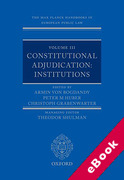
The Max Planck Handbooks in European Public Law series describes and analyzes the public law of the European legal space, an area that encompasses not only the law of the European Union but also the European Convention on Human Rights and, importantly, the domestic public laws of European states. Recognizing that the ongoing vertical and horizontal processes of European integration render legal comparison the task of our time for both scholars and practitioners, the project aims to foster a better understanding of the specific European legal pluralism and, ultimately, to contribute to the legitimacy and efficiency of European public law. The first volume of the series began this endeavour with an appraisal of the evolution of the state and its administration, offering both cross-cutting contributions and specific country reports. The third volume (the second in chronological terms) continues this approach with an in-depth appraisal of constitutional adjudication in various and diverse European countries. Fourteen country reports and two cross-cutting contributions investigate the antecedents, foundations, organization, procedure, and specific approach to constitutional issues throughout the Continent.
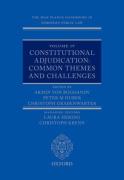
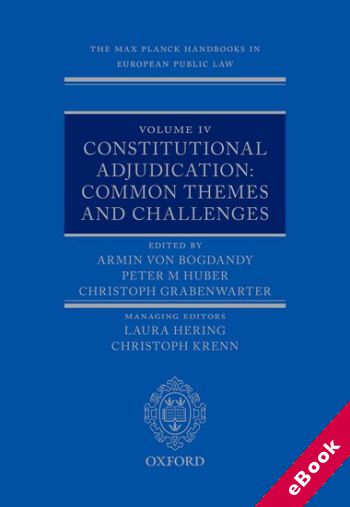
The fourth volume now compares European constitutional jurisdiction in the European legal space. It examines the structures of the organization, the appointment of judges, the procedures and the methods of argumentation and interpretation, their impact on state and society, their legitimacy as well as their role in the division of powers, and thus completes the picture following the country reports in Volume III. This comparative perspective is supplemented by an examination that illustrates the relationship with the ECJ, the ECtHR, and the Venice Commission as well as their (constitutional) function. Finally, Constitutional Adjudication: Common Themes and Challenges is devoted to the challenges constitutional jurisdiction in the European judicial area is currently facing. The historical, political, and theoretical foundations as well as the basic dogmatic features of constitutional jurisdiction are presented in such a way that the discussion about its role and further development in this legal space is sustainably stimulated.