
The eBooks we sell are sold as a single-user licence and are intended for the end user only.
The sale of some eBooks are restricted to certain countries. To alert you to such restrictions, please select the country of the billing address of your credit or debit card you wish to use for payment.
For further information see https://www.wildy.com/ebook-formats
Once the order is confirmed an e-mail will be sent to you to allow you to download the eBook. For UK purchases this will be automatic. For purchases outside the UK a member of staff will need to confirm the sale. (Staff are available to do this during normal business hours, Mon-Fri 8:30-17:00 UK time)
All eBooks are supplied firm sale and cannot be returned. If you believe there is a fault with your eBook then contact us on ebooks@wildy.com and we will help in resolving the issue. This does not affect your statutory rights.
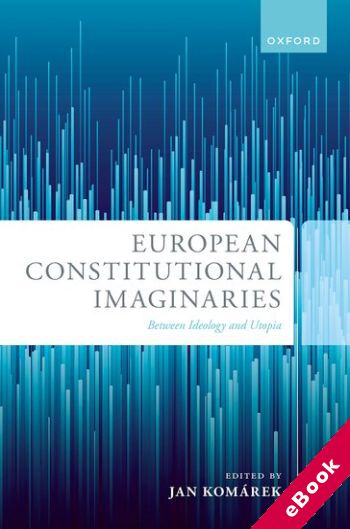
How can the EU be made legitimate and sustainable through (constitutional) law - and what is the role of constitutional lawyers and their ideas in creating this "sense of legitimacy"? This book seeks to answer these questions through the concept of the "constitutional imaginary": sets of ideas and beliefs that motivate and justify the practice of government and collective self-rule. Constitutional imaginaries are as important as institutions and office- holders, as they provide political action with an overarching sense and purpose recognized as legitimate by those governed. Constitutional imaginaries are 'necessary fictions' that make political rule possible, and at the same time they are ideologies which hide from view various forms of domination.
European Constitutional Imaginaries deals with a variety of questions and is split into four parts to address: the first part explores in more detail various meanings of European constitutional imaginary, as seen by different disciplines: legal sociology, political and constitutional theory, and philosophy. The second part revisits the contribution of some key authors to the creation of European constitutional imaginaries, and the third part offers various new ways of thinking about European constitutionalism. The fourth and final part examines political economy behind various constitutional imaginaries.
Written by a balanced mix of well-established authors and newer talent, European Constitutional Imaginaries promises to open debates on European constitutionalism that are necessary to understanding Europe's present predicament and its various crises, all navigated through the medium of law.










