
The eBooks we sell are sold as a single-user licence and are intended for the end user only.
The sale of some eBooks are restricted to certain countries. To alert you to such restrictions, please select the country of the billing address of your credit or debit card you wish to use for payment.
For further information see https://www.wildy.com/ebook-formats
Once the order is confirmed an e-mail will be sent to you to allow you to download the eBook. For UK purchases this will be automatic. For purchases outside the UK a member of staff will need to confirm the sale. (Staff are available to do this during normal business hours, Mon-Fri 8:30-17:00 UK time)
All eBooks are supplied firm sale and cannot be returned. If you believe there is a fault with your eBook then contact us on ebooks@wildy.com and we will help in resolving the issue. This does not affect your statutory rights.
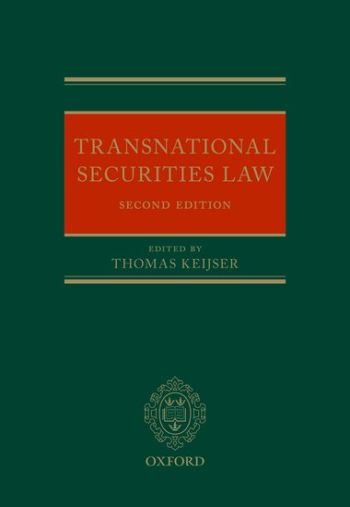
Bringing together a team of globally renowned academics and expert practitioners in the field, Transnational Securities Law, Second Edition, presents a comprehensive analysis of the international harmonization of the law relating to securities. The book focuses on private law, insolvency law, and conflict-of-laws issues, as well as providing in-depth guidance on recent regulatory and technological developments. Each chapter assesses the current state of the law, and, for issues that have not yet been harmonized, identifies best standard practice solutions.
This fully revised and updated edition considers the regulatory intervention in the wake of the global financial crisis and the impact of ground-breaking technological innovations in the securities markets, with a particular focus on blockchain and other types of distributed ledger technology, smart contracts, and crypto-securities. In so doing it addresses the paucity of attention given to issues of investor protection and custody of digital assets, and provides guidance on the development from legacy technology to a landscape in which a variety of DLT solutions are increasingly applied. It furthermore proposes an approach toward solving or ameliorating prevailing legal and regulatory problems with enhanced systems, infrastructures, regulatory approaches, and private-law doctrine.
Alongside the well-established and comprehensive analysis of securities law at the transnational level, this new edition continues to provide best-practice solutions for practitioners working in the field of securities law.










