
The eBooks we sell are sold as a single-user licence and are intended for the end user only.
The sale of some eBooks are restricted to certain countries. To alert you to such restrictions, please select the country of the billing address of your credit or debit card you wish to use for payment.
For further information see https://www.wildy.com/ebook-formats
Once the order is confirmed an e-mail will be sent to you to allow you to download the eBook. For UK purchases this will be automatic. For purchases outside the UK a member of staff will need to confirm the sale. (Staff are available to do this during normal business hours, Mon-Fri 8:30-17:00 UK time)
All eBooks are supplied firm sale and cannot be returned. If you believe there is a fault with your eBook then contact us on ebooks@wildy.com and we will help in resolving the issue. This does not affect your statutory rights.
In recent years, many breaches of immigration law have been criminalised. Foreign nationals are now routinely identified in court and in prison as subjects for deportation. Police at the border and within the territory refer foreign suspects to immigration authorities for expulsion. Within the immigration system, new institutions and practices rely on criminal justice logic and methods. In these examples, it is not the state that controls the national border: instead, it is often privately contracted companies.
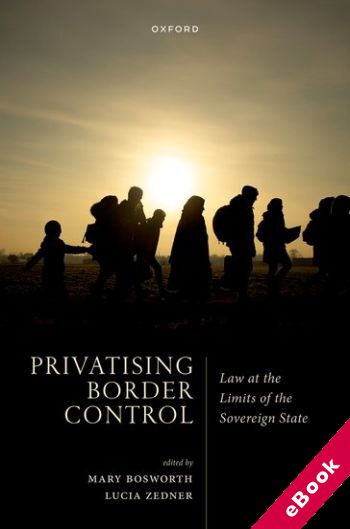
This collection of essays explores the growing use of the private sector and private actors in border control and its implications for our understanding of state sovereignty and citizenship. Privatising Border Control is an important empirical and theoretical contribution to the growing, interdisciplinary body of scholarship on border control. It also contributes to the academic inquiry into the growing privatisation of policing and punishment. These domains, once regarded as central to the state's police power and its monopoly on violence, are increasingly outsourced to private providers.
With contributions from scholars across a range of jurisdictions and disciplines, including Criminology, Law, and Political Science, Privatising Border Control provides a novel and comparative account of contemporary border control policy and practice. This is a must-read for academics, practitioners, and policymakers interested in immigration law and the growing use of the private sector and private actors in border control.











